

They were brought to Dorset, escaped almost immediately and never left. Jane Adams looks at our complicated relationship with sika deer – and asks how many our landscape can sustain.
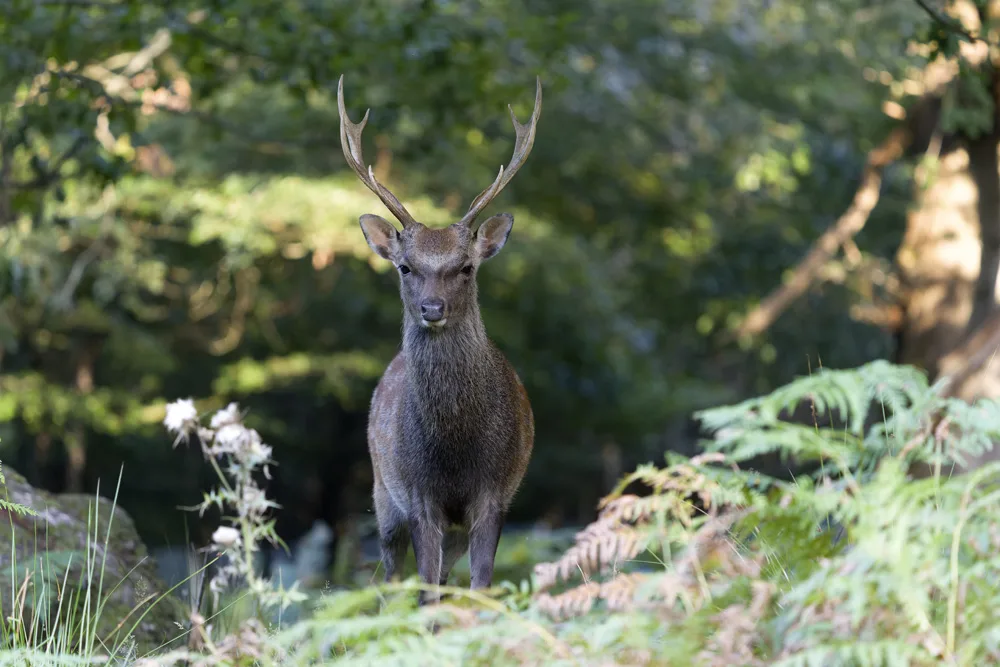
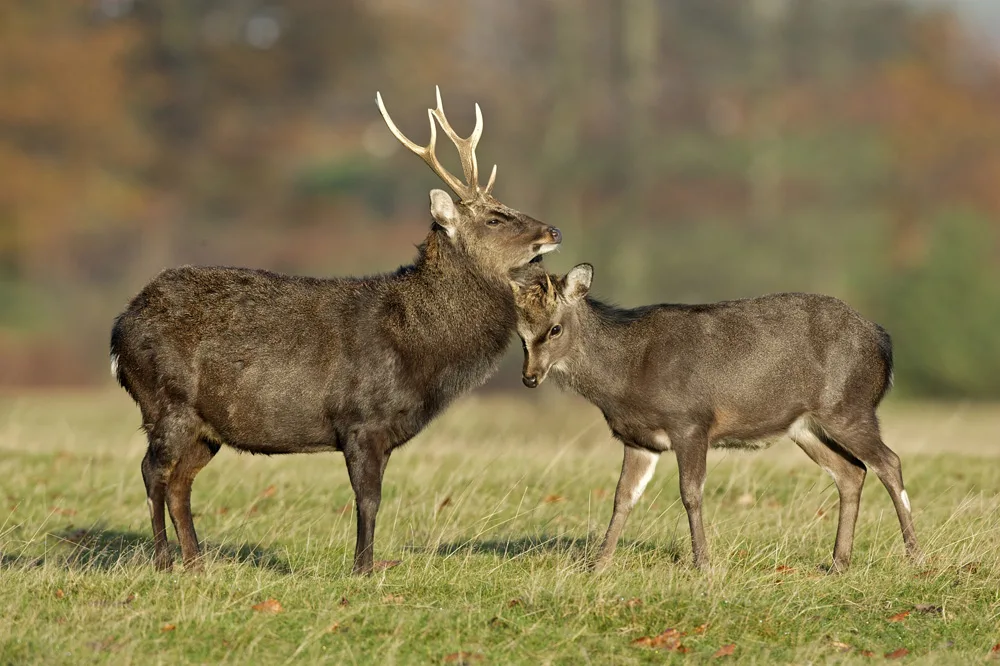
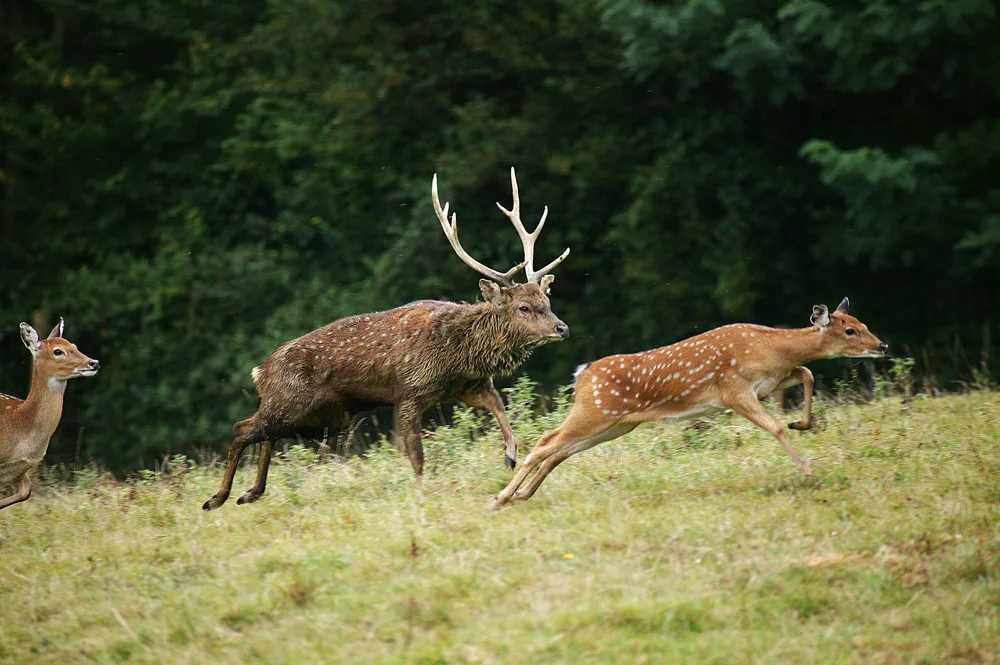
In winter, they become a darker grey or brown and the spots become very faint or disappear. They have a white rump with a black border at the top. Males develop branched antlers of up to eight points. A mature stag can weigh around 40-70 kg; females (called hinds) are considerably smaller.
It’s early October on a still, warm autumn evening, and the badger sett I’m walking to is on the edge of an overgrown clay pit not half a mile away. I don’t usually approach it from this direction – through the conifer plantation – and I’m surprised at how dark it is, slightly spooky, even. To my left, a branch cracks, then there’s a very human-sounding scream. I freeze, skin prickling. More yells, groans, then the sound of crashing through undergrowth, culminating in a brittle clash.
Luckily, I haven’t just walked into a messy murder scene. It is sika stags fighting to win the favour of hot-for-it females. I have no idea where they are, but the noise seems to come from everywhere. It’s a primeval sound, and the hairs rise on the back of my neck.
Sika are native to Japan and parts of East Asia, but there is nothing old about them in Dorset. The county’s first sika herd was introduced to Brownsea Island in 1896. On that day, it’s said several animals waded into the water and immediately swam to the mainland. So much for keeping them contained. Then came a second introduction a few years later at Hyde House Deer Park, near Wareham. That herd was ultimately freed during the Second World War, when the government commandeered the estate.
How many is enough?
Sika deer have adapted remarkably well to our landscape. As well as grazing on wetlands and reed beds, they love eating heather. No surprise, then, that they have spread across our lowland heaths and conifer plantations, eventually pushing further inland into farmland stitched together by small wooded copses.
So, should we worry about them being here?
At high densities, they can stop woodlands from naturally regenerating and change how existing woodlands grow. They eat plants we are trying to conserve, and they can damage farmland crops and sensitive habitats. They can even hybridise with our native red deer. But it’s the sheer number of deer, rather than the deer species itself, that causes actual problems.
For many, sika deer have become part of the wild experience of Dorset. Watching a large sika stag wander nonchalantly through the car park on a visit to Arne is something you’re unlikely to forget. Conservationists, on the other hand, can look at these same animals and see an introduced herbivore putting pressure on already scarce resources.
The trouble is, both things can be true at the same time.
With no top predators – such as wolves – in Britain, landowners and conservation organisations already use culling to manage populations of both native and non-native deer. But just because we artificially introduced sika doesn’t mean they should all now be culled. The question we should ask instead is how many deer, of any species, can our landscape can sustain.
Never just a spreadsheet
It’s a different October, and I’m sitting in a tree overlooking a reed bed on the edge of Poole Harbour. Below me is a herd of sika deer: females, last year’s youngsters, and, on the fringe, some pumped-up stags trying to impress. Within the herd are a few rare white females and one white stag. As they splash through the water, their reflections float, ghost-like, above the darkening sea.
Watching them from the tree, it’s difficult to reduce such a wild animal to a number on a spreadsheet. But we brought the sika here. They stayed. They thrived. And now, having given them a place in our landscape, we must decide what happens to them next.
By Jane Adams