

A small patch of grass at Coles Close in Sturminster Newton has become the focus of a surprisingly difficult question. The town needs more allotments, and the green space sits conveniently beside the existing Filbridge Rise allotments. But local families say this apparently ‘under-utilised’ land is already doing an important job: their children play there.
What looked like a straightforward opportunity to create more growing space has instead raised questions about how communities use their remaining green spaces – and what happens when the infrastructure promised alongside new development has to find a home elsewhere.
In 2023, Sturminster Newton Town Council reviewed the green space outside houses at Coles Close, considering the options available on land that appeared to be underutilised in a growing town.
Councillor Pauline Batstone outlined the issue: ‘It was realised this was adjacent to Filbridge Rise Allotments, which is why that option was considered. In fact it’s a very pleasant area of grass between a row of houses and Butts Pond. The council worked with the allotments committee … and then the residents raised concerns.’
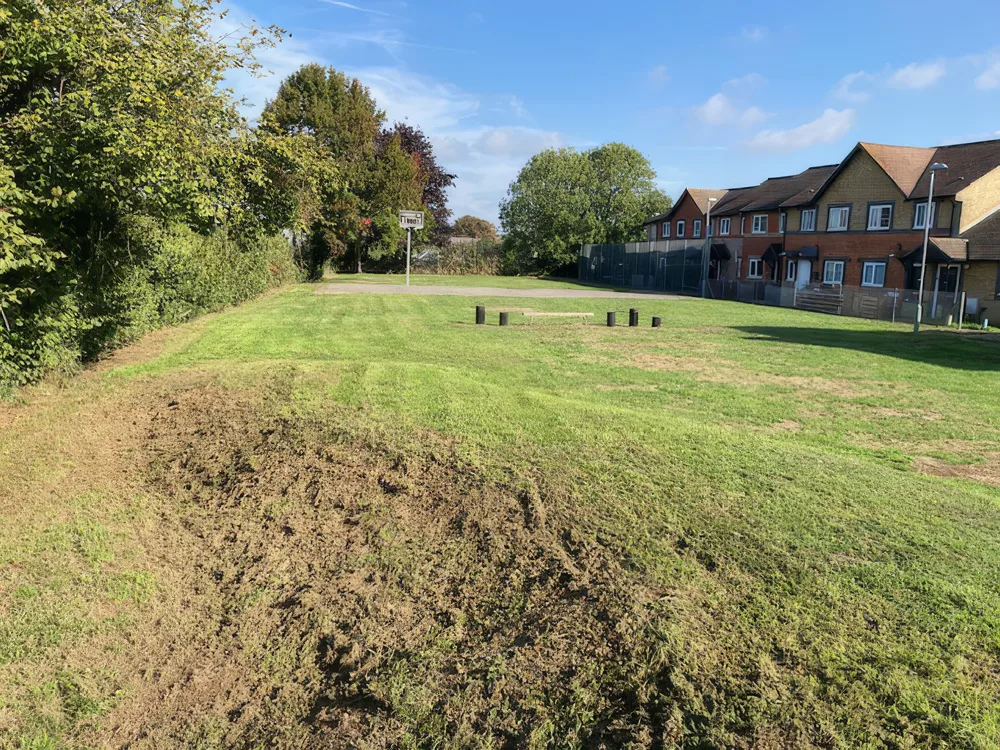
Image: Pauline Batstone
The rising demand for allotments Mike Burt, chairman of Sturminster Newton Allotments Society, has a long list of people in Sturminster Newton keen to have the opportunity to grow food on an allotment: the rising cost of living is encouraging more people to grow their own.
‘I have five waiting on Filbridge Rise,’ he says. ‘And four on our very small Chinnocks site, which are classed as kitchen gardens. Our Filbridge allotment site used to have 20 big plots. Because of demand and trying to allow everyone to enjoy the experience, we have had to split plots in half. I cut one into four recently. We’re trying to allow people to enjoy the allotments and get a foothold.
‘When the town council looked at Coles Close in 2023 they thought the area could be used for car parking or social housing. The residents objected back then to a play space. I’m in favour of keeping green spaces – we are getting hammered and losing these spaces in the town.
‘We saw an opportunity to promote the allotments, especially as we had a natural extension and could extend the water supply.
‘The council produced a leaflet to consult with residents which we helped distribute, including in Coles Close and the town. Sixty six people agreed to the idea, one couple didn’t want it and one person wanted to find out more. The council unanimously agreed to support it. There was also a compromise to split the area into allotments and a play area.’
Not on my watch
But residents living around Coles Close now say the space is not underused at all. Jo James is a local resident who worked together with Lena, another Coles Close resident, to oppose the plans.
‘The first we knew was a leaflet through the door with a QR code that didn’t work – though we were told to use it.
‘Children are out there every evening. It’s not underused.
‘It’s right outside my door – it reduces an already-small green space to even less, and we end up with the narrow bit with a footpath running through it.
‘Lena initiated a petition and we’ve been working together. I was nervous going to the council meeting – around 12 of us went together. We have given them a lot of paperwork, including letters asking them to provide evidence. We now have 77 signatures opposing the allotments.’
The amenities committee has recommended that the plan be reconsidered. As it has no delegated powers, that recommendation will go to the full Town Council on 7th October. But the argument over Coles Close raises another question: why is a Town Council having to find somewhere for additional allotments in the first place?
The Town Council says the original Corallian Heights development included allotments, but these were later omitted when variations to the plans were approved by Dorset Council. Section 106 funding was agreed instead, with conditions requiring the new allotments to be accessible to Corallian Heights residents.
But money does not create land. The Town Council says it approached neighbouring landowners without success, leaving Coles Close as its only identified option within the funding criteria. If the money is not used within ten years of its receipt by Dorset Council, it will be returned to the developer.
At the council amenities meeting, Mike said he would not entertain any conflict between the allotments or residents in the town: ‘It will not happen on my shift,’ he says.
Cllr Batstone was at the meeting: ‘Residents were able to have their say,’ she told Dorset Life. ‘The council listened, and will review the position. Together with the residents they will come up with a new plan. My view is that it’s not the place for allotments – the residents want a place for children to play. Maybe it just needs a low-impact approach that needs a bit of tidying up. One of the issues with a place like this is the demographic: needs keep changing as the children get older. However, we still do need allotments and the big question is where can they go?’
Where allotments should go – or should have been put in the first place – leads to the bigger question to come from this issue. When infrastructure included in a new development is subsequently removed from the plans, can replacement funding always provide an adequate substitute?
For now, the allotments still need a home. And the children of Coles Close would rather their playing space wasn’t it.