

Although the evenings are drawing in, there’s one thing that brings the equestrian community together – attending the talks and events that we’re otherwise too busy for during the summer months.
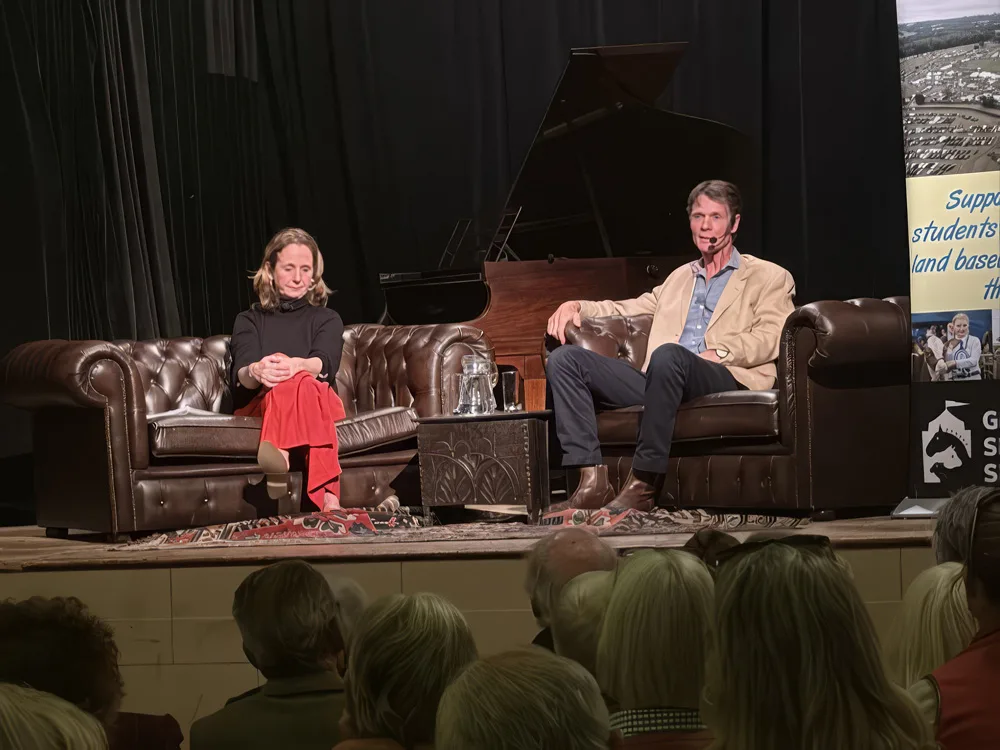
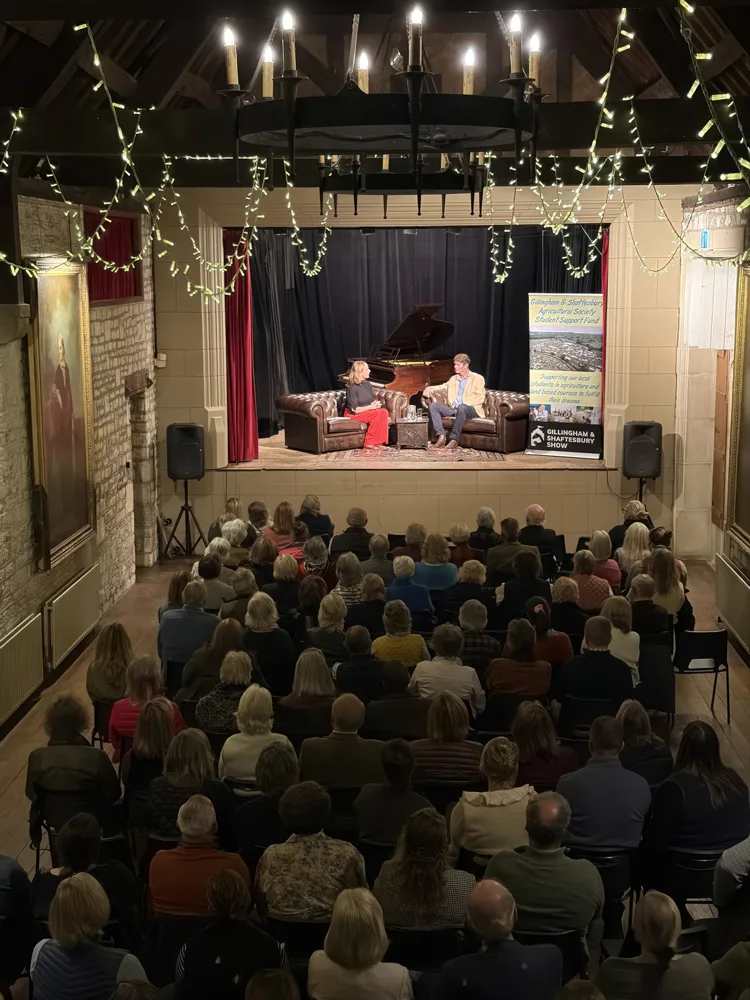
One such evening in October was hosted by eventing Olympian William Fox-Pitt and broadcaster and former event rider Alice Plunkett at their home on the Hinton St Mary Estate. The evening was in aid of the Gillingham & Shaftesbury Agricultural Society’s Student Support Fund, which helps the next generation of agricultural and land-based professionals access the education and training they need.
Drawing on two remarkable careers at the highest levels of eventing and racing, Alice and William shared stories from horses, broadcasting and family life – and explained why supporting the next generation matters to them.
William’s eventing career took off with one of his mother’s ex-racehorses: ‘He was a real character – he took me to my first 4* at Bramham,’ he says. ‘But you couldn’t do sitting trot on him, which was quite difficult in the dressage test! We also had to tie my coat tails to the saddle as he couldn’t stand them touching him.’
Reflecting on how he can get a tune out of most horses, William explained that he thinks this was largely down to riding such a variety of horses in his early years through his mother’s horse-breeding programme.
‘That, and being around so many experienced riders at events like Bramham, which gives you so much information that lessons just can’t give you.
‘That’s not to say it was all easy-going from the start, however. My mother was always focused first on the horses,’ he says. ‘At my first Badminton she was concerned I was too tall and heavy for the horse, so she made me ride round in a seven-pound racing saddle. You’d never see an eventer doing that nowadays!’
She also insisted William get off and run alongside his horse during the roads and tracks phase – this was before eventing changed to its current format. It’s clear he had a solid foundation in putting the horse’s welfare first and treating each one as an individual:
‘I always say one of my biggest senses of achievement during my career is getting the best result for that horse. You get those little victories which often don’t involve a fancy rosette.’
Alice brought a different perspective from her own years as an event rider and her long broadcasting career in racing. She explained that doing well in racing can look rather different from eventing:
‘People would ask how you got on at an event and you’d reply, “Oh, they did so well, they came 12th!” – in racing terms that is nothing to be proud of!’
William told the story of his first sponsorship, which came at a relatively young age: ‘My parents gave me the ultimatum that I either found a job or went to university. Obviously I went to university, and chose the longest course possible. But after that I had to work out how I’d carry on,’ he said. He initially managed this with his first sponsorship, from Smirnoff Vodka. ‘I thought I’d won the lottery – I was given £5,000, free vodka and a red lorry!’
He won his first 5* aged 24, suddenly finding himself riding alongside some of the best in the sport.
Quick, I need a tip
Reflecting on his career highlights – of which there are many – he told the audience that the London 2012 Olympics were among the best.
‘In other Olympics the equestrian sports are often held at a different venue, sometimes in another part of the country,’ he said. ‘It was amazing to be among other Team GB athletes. One morning I was there just having breakfast with Andy Murray.’
Alice pointed out that a photograph of William with the Team GB basketball team is one of the only pictures they have in which someone is taller than him – which, at 6ft 6in, is no mean feat.
While William’s eventing career was taking him around the world, Alice was raising their family and helping to run the yard, while also maintaining her own career as a racing broadcaster.
‘I love finding the human stories and what links them to racing,’ she explained. ‘It’s really important to stay in your lane when you’ve got other big presenters, and for me that’s what’s important – most people tune in to watch horses like Kauto Star, not necessarily for the racing itself.’
She has had many memorable experiences over the years, but one in particular sprang to mind: ‘An owner had just won a race at Cheltenham and was quite emotional. She said she and her husband had been dreaming of this moment for a long, long time. When I asked where her husband was, she replied, “He’s in my handbag!”’
Alice told the story of when ITV bought the rights to broadcast racing, and the presenters had to re-interview for their own jobs. In the lift on the way to her interview, Ant and Dec got in.
‘They asked me for a tip, and I was frantically texting friends to see if they could give me some suggestions!’
‘2015 was another extraordinary year for us,’ Alice said. ‘Will had won Badminton on Chilli Morning and then I had a phone call which I thought at first was a prank.’
The caller said he was ringing from Buckingham Palace. ‘I asked if I could call them back, and when I did I realised it was genuine – the Queen was inviting William to watch the racing at Ascot with her!’
They had an extraordinary lunch, with the prizes won by the late Queen’s racehorses lined up behind them.
‘She had all these small plates around her and then a member of her household came in, put some treats on them, put them on the floor and all the corgis came trotting in.’
Having a lovely time
It was later that year that William suffered a head injury during a serious fall at the World Young Horse Championships in France, causing him to lose his balance, his short-term memory and, temporarily, his eyesight. Knowing the 2016 Rio Olympics were just around the corner, he was determined to get fit and back in the saddle. ‘It gave me the drive to get out of bed and on the road to recovery,’ he admitted.
For Alice, it was a balancing act.
‘We would have people challenging us and asking, “What on earth are you doing?” I was essentially facilitating someone who was very vulnerable, getting into a dangerous situation by getting on a horse when their balance, memory and eyesight had gone. But he had the innate talent and muscle memory – although I’m going to add that I would not encourage anyone else to follow this kind of path to recovery.’
Most equestrians will tell you that horses sense vulnerability, or at least understand when they need to be gentle and look after you, and two of William’s horses really stepped up.
‘Cool Mountain and Chilli Morning really read the situation – they really looked after him,’ Alice said. ‘Will was meant to be escorted on all rides, but I came home one day and he’d just gone out by himself. After frantically driving around looking for him, I found him just wandering along through the fields on Chilli, having a lovely time.’
Supporting who comes next
If there was one thing that became very clear throughout the evening, it was that Alice and William’s interests extend well beyond their own equestrian careers. They have helped set up the Community Hub in Hinton St Mary and also own the village pub, the White Horse, part of their Hinton estate. There, 5p from the sale of every pint of one of its beers goes back into the village fund, while the menu changes depending on who has an abundance of produce locally. ‘This place has been farming for generations, but farming is changing,’ Alice said. ‘You’ve got to think about other areas and how to support the next generation.’
Which is exactly what the Student Support Fund does. Set up in August 2020 by the Gillingham & Shaftesbury Agricultural Society, the Fund helps towards the costs of college or university courses for agricultural or land-based qualifications, including fees, books, equipment and transport.
With farming facing a difficult future, it’s a practical way to help the next generation develop the skills they need to become part of it.
Support can be made by contacting the G&S Agricultural Society office on 01747 823 955. gillinghamandshaftesburyshow.co.uk
By Tamsin Doar