Two years ago, Henry Adams swapped Whitehall and a career in the Royal Navy for the family farm near Sherborne. With his wife Ellie, he is now attempting to reinvent the farm he grew up on – one orchard, experiment and award-winning egg at a time. Courtenay Hitchcock meets the couple behind Orchard People.
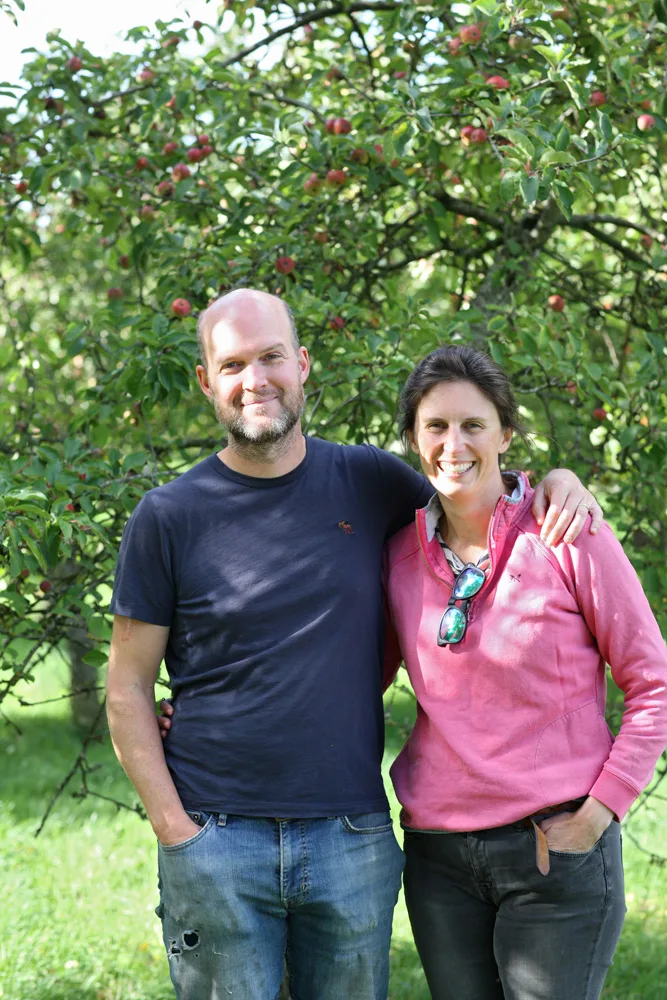
All images: Courtenay Hitchcock
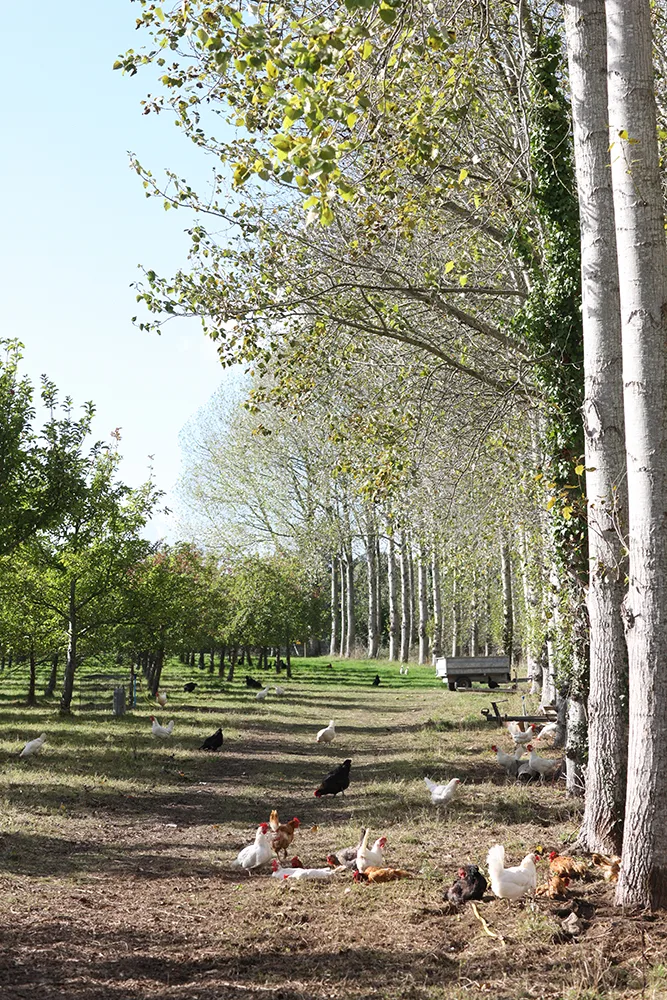
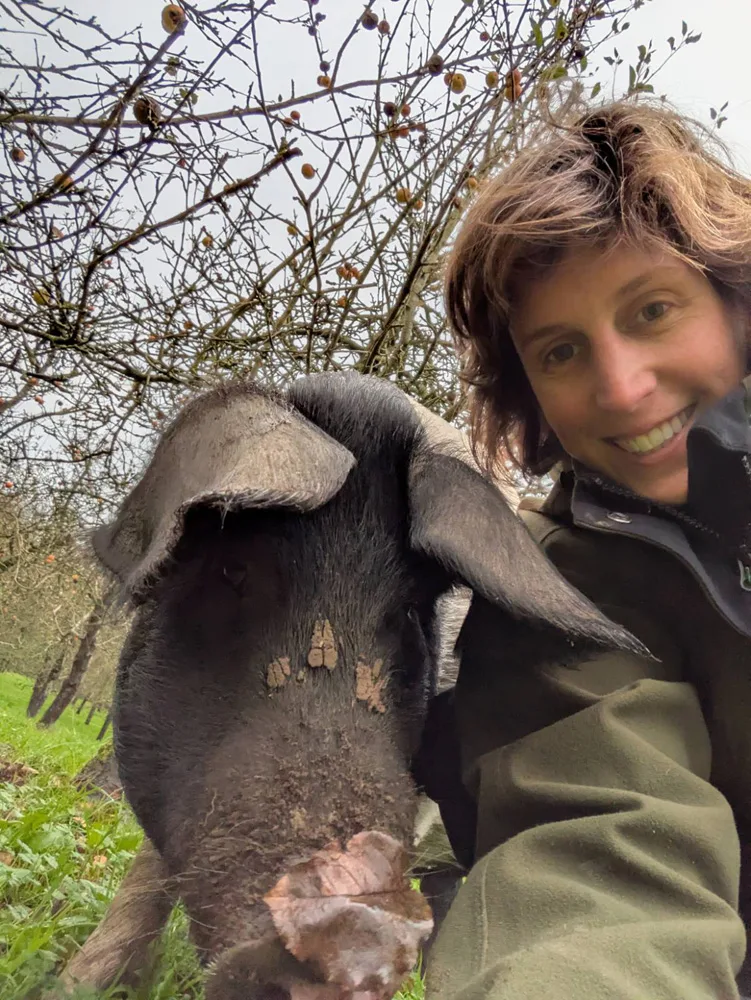
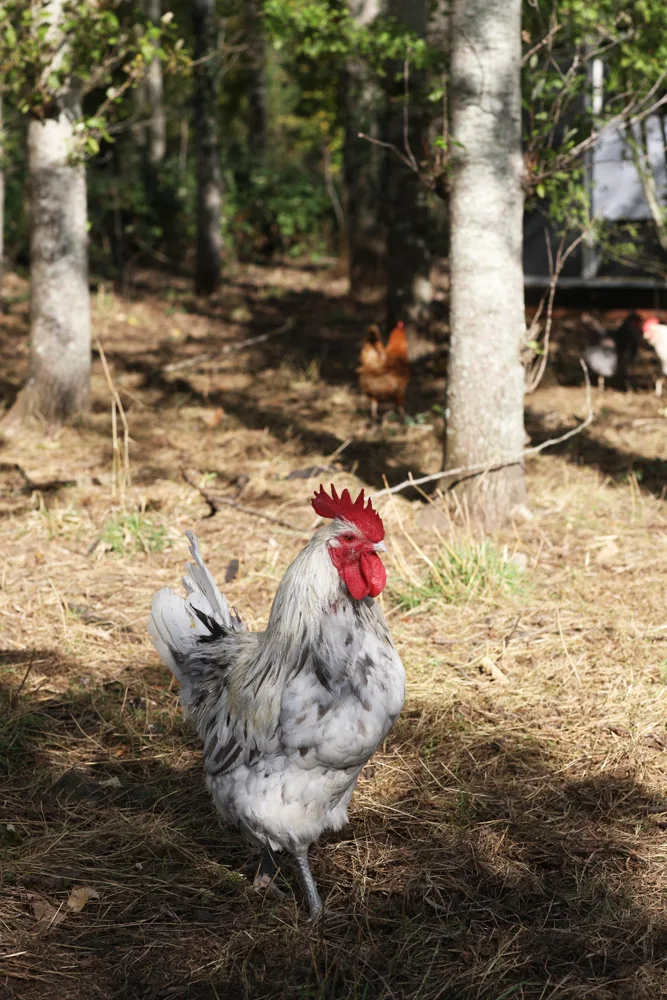
There are 10,000 cider apple trees on Henry and Ellie Adams’ farm near Sherborne. Between the trees wander chickens– lots of chickens – pecking through the grass and providing both eggs and, rather usefully, fertiliser.
There are pigs too. Sheep are part of the plan, along with eating apples, vines, perhaps bees (again … that particular experiment did not end well the first time round) and, eventually, a couple of cabins where visitors can stay on a working organic farm.
It is all part of Orchard People, Henry and Ellie’s attempt to work out what a small Dorset farm can become.
Henry grew up on this farm, after his parents bought it in 1987. What he emphatically did not do was grow up wanting to be a farmer.
Instead, his route home involved university, living on a tiny sailing boat, crossing the Atlantic, working at the BBC, joining the Royal Navy, navigating minehunters and eventually sitting in high-powered meetings in Whitehall.
‘It’s a straight line,’ he says. ‘An absolute straight line.’
His parents’ journey to the farm had been similarly unconventional. His father had worked in merchant banking, his Norwegian-speaking mother had taken Scandinavian Studies and the pair had lived together on a narrowboat. Henry remembers them saying they chose Dorset because it had no motorway. ‘They’re a bit wacky,’ he says, with affection. ‘Square pegs in round holes.’
They bought a farm that had once belonged to the Leweston estate and had latterly been a dairy farm. They gradually removed redundant buildings, made a family home and experimented with different ways of using the land before settling on cider apples.
Meanwhile, Henry left.
‘It never really crossed my mind that I would go into farming or take on the farm.’
After Durham University, where he studied natural sciences, philosophy and psychology, he spent a year sailing across the Atlantic and back in a small boat.
‘I did it because I like boats. And I didn’t want a proper job.’
Eventually he decided that perhaps he did. After a spell digitising audio archives at the BBC – ‘lovely and very dull’ – he joined the Royal Navy in 2010, staying for 14 years.
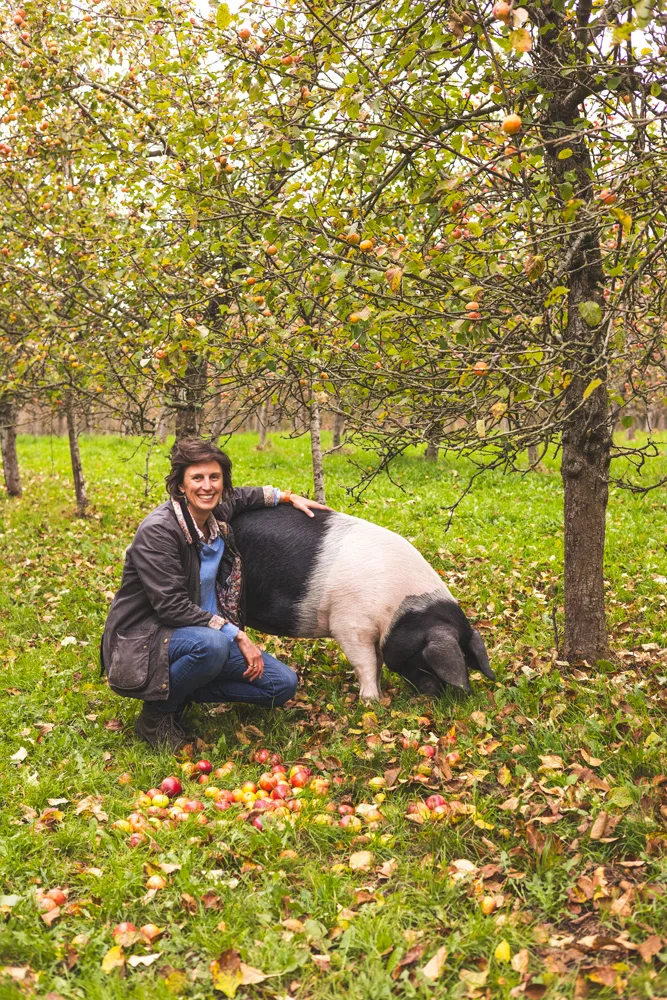
Image © Lara Jane Thorpe Photography
Coming home
In the meantime, he re-met Ellie, whom he had barely known when they were at university together. They married, had three daughters – Lily, Penny and Isabel – and built careers and a life away from Dorset. Ellie worked for Reuters in Washington DC and later Deloitte. Then, as Henry puts it, Ellie got to have her midlife crisis before him. A fluent Mandarin speaker, she left Deloitte and set up QIVA Global, which helps Western companies enter the Chinese market.
Henry’s midlife crisis soon followed and the couple found themselves reading about ultra-processed food, regenerative agriculture and the fragility of global food systems. They spent more than a year looking at farms for sale across Dorset and Somerset before the obvious possibility finally came into focus: Henry’s father was ageing and the family farm itself needed a future.
Henry decided to leave the Navy and he and Ellie agreed to take on the farm. His father died just a few months later.
‘We kind of thought, well, I guess we’ve got to do this. Let’s do it.’
They sold their house, bought out Henry’s brother and sister and moved to the farm in August 2024. There was just one slight problem – suprisingly, Henry knew very little about farming.
A year of books, YouTube and intensive reading on regenerative agriculture had helped, but the real education was about to begin.
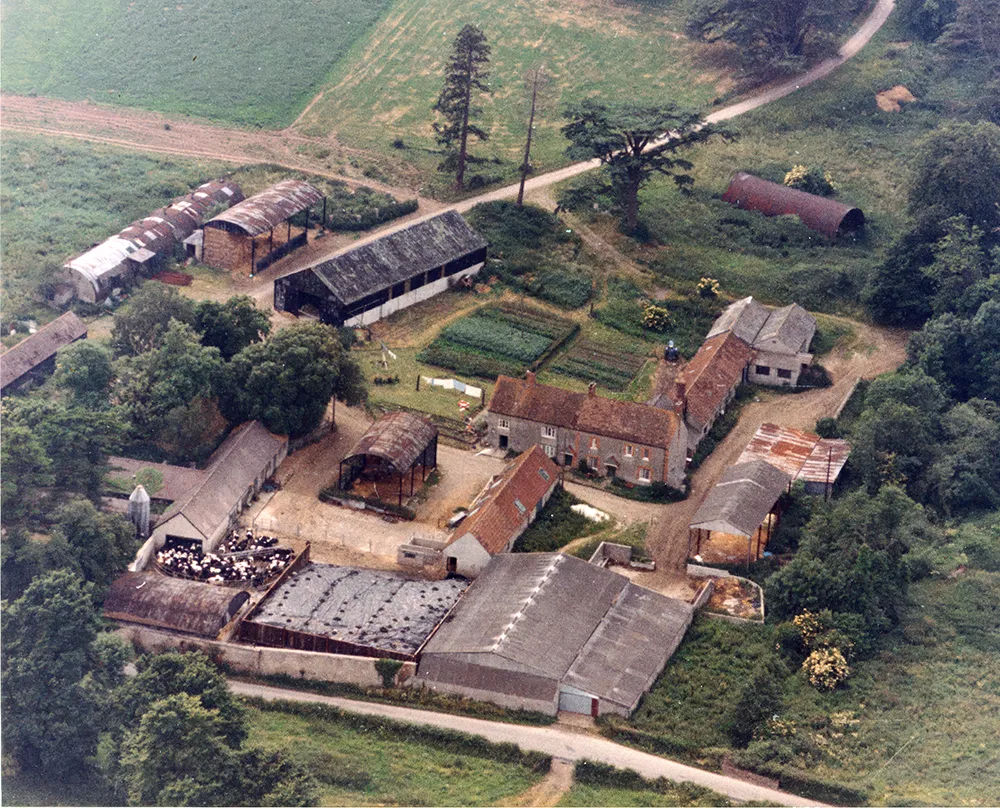
Image: Henry Adams
Chicken TV
The chickens arrived years earlier. Someone near their previous home was trying to rehome some particularly fancy hens, but Henry and Ellie’s muddy garden was deemed unsuitable (much to Ellile’s irritation), so Henry went on Gumtree and bought six less discerning chickens for £30.
‘These poor little bedraggled things weren’t in the best condition,’ he says. ‘But they had a lovely time. We used to go out and sit on the bench with our nine-to-five commuting jobs and our mortgage and watch chicken TV.’
They were hooked.
And in Dorset, chickens made practical sense too. The couple wanted to improve the orchard without relying on chemical fertilisers: hens could graze beneath the trees while naturally returning nutrients to the soil.
Five months before they were allowed to sell certified organic eggs, they bought 300 day-old chicks and raised them in an old barn beside the kitchen. Commercial egg production only began a year ago.
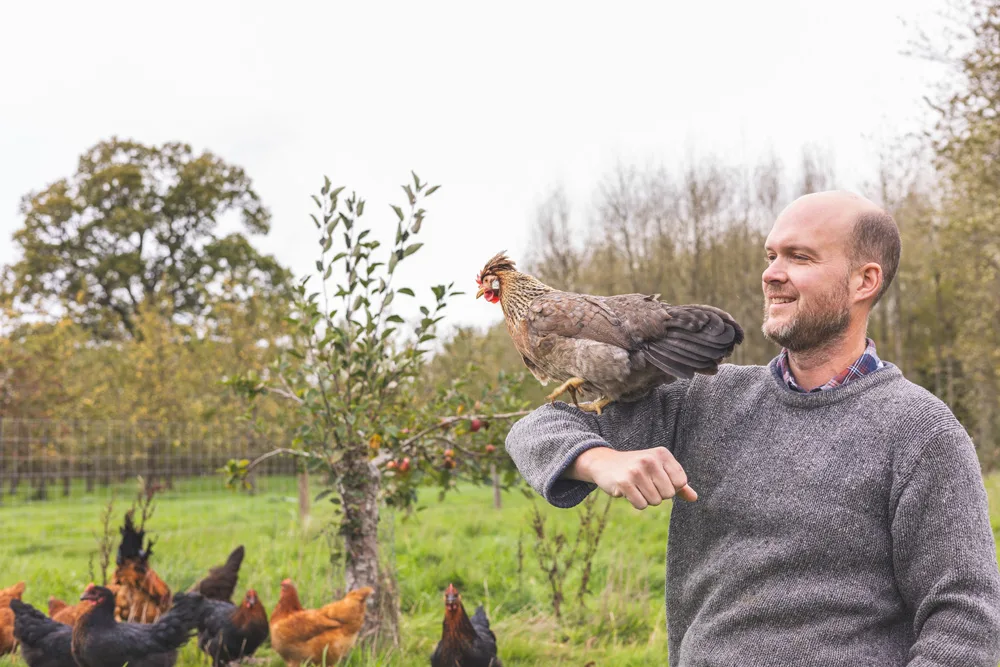
Image © Lara Jane Thorpe Photography
Since then there has been a fox, red mite, summer heat, fencing problems and a great deal of learning … but there has also been rather unexpected success.
Wanting a gold sticker for the boxes (‘I thought it would be cool if I got one of those,’ says Henry), he entered their eggs for the Great British Food Awards. They not only won gold but Orchard People was named South West Regional Champion 2026.
Henry and Ellie took Fin and Betsy, both part of the farm team, to London for the ceremony, but they missed their train and arrived 20 minutes late … also missing the moment they were called to the podium.
Henry still seems faintly baffled by the award: ‘We’ve got these really nice chickens with some slight heritage breeding and we put them in the orchard, where they’ve got loads of lovely shade from the trees and lots of nice grass to eat.
‘It seems really obvious – it shouldn’t be getting national awards for being incredible, because we just put some chickens in a field.’
He pauses.
‘I’m starting to believe that they are actually really good eggs.’
An orchard full of ideas
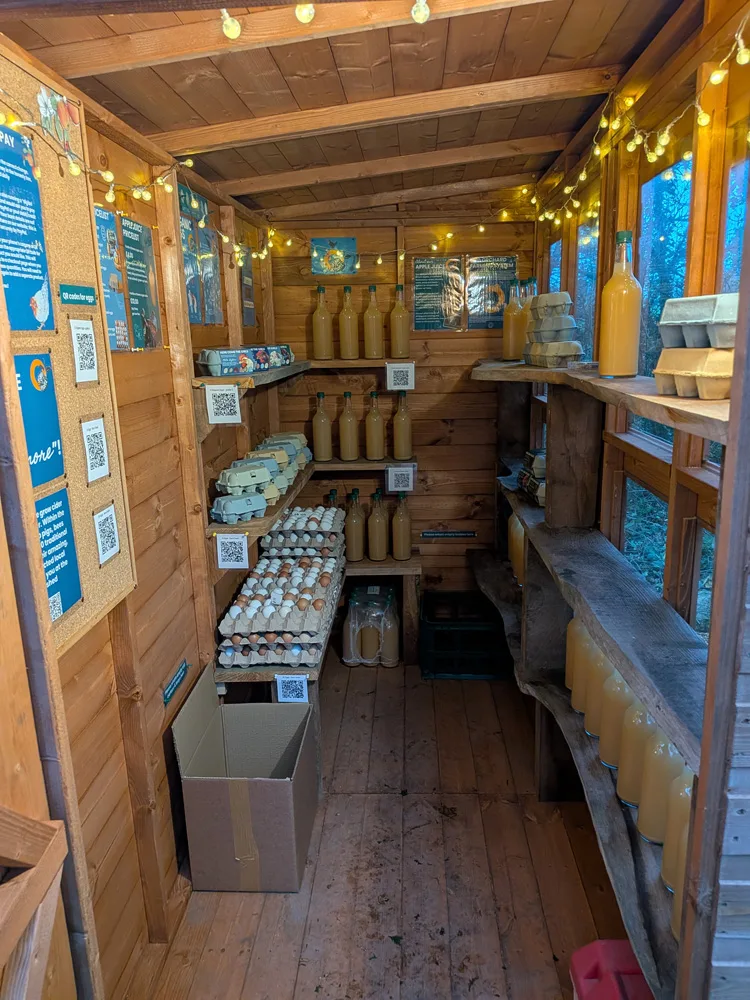
Eggs are only the beginning though. The 68-acre farm includes around 30 acres of cider orchard. Henry and Ellie have started grafting eating-apple varieties onto some of the existing trees.
They are also experimenting with pigs and other livestock in the orchard. Their first venture into beekeeping went from three colonies to five remarkably quickly – and then, after wasps, varroa and two colonies simply leaving, from five to none.
‘We like experiments,’ Henry says. Some work.
Some emphatically do not.
The bigger ambition is for Orchard People to become exactly what its name suggests: a place with more people in it.
Henry and Ellie are actively looking for individuals or businesses interested in bringing complementary enterprises onto the farm. A fenced acre of orchard could potentially accommodate a market gardener, flower grower or another small-scale enterprise, and they are already working with Landmatch England to explore possibilities.
‘We’d like to build a big team here. We don’t want to be in charge of all of them, but we’d like to be the coherence that brings everybody together. We want to be the designers of the system where everybody flourishes here.’
There is an economic necessity behind the vision. Henry is refreshingly frank about that too. The farm lost money in year one and year two. The couple expects it to lose money in year three, too: ‘In year four or five, let’s hope it can make some money.’
Henry talks passionately about regenerative agriculture and rebuilding local food systems, then catches himself when the language begins floating too far above the balance sheet.
‘I feel a little bit odd saying we’re part of a cure,’ he corrects himself. ‘At the moment, we’re just trying to make a farm that’s not making a loss.’
Different strengths
Orchard People may be Henry’s full-time occupation, but it is very much a joint enterprise. Ellie continues to run QIVA Global while co-owning the farm and shaping its strategy, finances, branding and direction. Where Henry can happily disappear into soil health, livestock and the practicalities of growing food, Ellie instinctively begins with the customer and works backwards.
‘She loves running a global business across time zones, speaking different languages and dealing with different cultures,’ Henry says. ‘But she absolutely thrives in us two working together and designing some of the business financials and the strategy and the vision.’
It sounds impressively complementary. The reality, Henry admits, also involves three children, two businesses, a farm and a Google Calendar requiring military levels of co-ordination: ‘We just sort of struggle along, both trying to work full time, both trying to parent full time. We’re just at that stage of life. It’s a bit of a grind.’
For all the ambitious language around regenerative farming and resilient local food systems, perhaps that admission gets closest to what Orchard People really is. It isn’t a finished model being presented as the answer to farming’s problems. It is Henry and Ellie, two years in, trying things. Some chickens thrive. Some bees leave. Apples have good years and terrible ones. Eggs unexpectedly win national awards. The books still need to balance.
For now, though, there are eggs to collect, cider apples to harvest and a farm to make pay. It may not have been the career Henry imagined when he left Dorset. But then his life has never travelled in a particularly straight line.
orchardpeople.co.uk
Independent Dorset journalism matters.
Dorset Life is free to read, and always will be. If you value the stories we tell, the questions we ask and the communities we give a voice to, you can help us do more of it.
Support Dorset Life →