

Following allegations of poor welfare on British dairy farms, Dorset farmer Tim Gelfs calls for scrutiny rather than defensiveness, arguing that abuse must be confronted – but so too must the pressures, practices and assumptions surrounding the industry.
I would always encourage anyone, when looking to make decisions, to be informed, to take a balanced approach and make their own judgement. This campaign isn’t balanced: it is there to promote their aim. But neither is a dairy advert of skipping cows – it is there to promote the industry.
I would encourage people to see farming for themselves as part of forming that judgement. It won’t answer every question raised by covert footage, but there are lots of farms willing to engage, and opportunities throughout the year to visit, look and ask difficult questions. If you come away with a view of, no, this isn’t for me, absolutely fine. You have made an informed judgement from your experience.
Not a neutral inspector
While I can respect AJP’s view and ambition – and they are quite right to hold people to account when animal welfare is compromised – I do question some of their methods and the way this investigation has been conducted. To trespass onto someone’s farm, without respecting any health and safety or biosecurity issues, is a real concern. Farms can be dangerous places and diseases can be easily spread. Where would they be if someone had had a serious accident?
We must also not forget that, yes, a farm is a business, but the majority of the time, it is also a family home. It leaves a sickening feeling, knowing that someone has been trespassing on your property and leaving monitoring equipment. How would any of the Animal Justice team feel if someone trespassed on their property, leaving surveillance equipment?
It leaves you not feeling safe, and knocks your confidence in leaving your home, especially if you are on a farm isolated in the middle of the country. I know – I’ve got the T-shirt!
Their motivation matters too. If animal welfare is the priority, why was some worrying footage apparently held for nearly a year rather than reported to the authorities immediately? AJP is not a neutral animal-welfare inspector; it is a campaigning organisation seeking an end to the industry it is investigating.
Retailers and processors
Now we must not forget the response from the large retailers and processors – they have swiftly suspended farmers from milk contracts, seemingly wiping their hands of it: “nothing to do with us, guv”.How dare they!
For decades they have been driving down the profitability of farming, abusing their buying power, using milk as a loss leader, offering promotional campaigns on cheese, while all the time expecting the dairy industry to pick up the tab. We have just seen a processor announce a 6p rise in September, then a 7p drop in December. How can anyone be expected to run a business in this environment?
How do we expect farmers to have all the checks and protocols in place and monitored when, most of the time, they are struggling to survive? None of that excuses poor welfare – it never can. But if processors and retailers expect ever-higher standards, they also have a responsibility to ensure the price paid makes those standards sustainable. It is no surprise that we have lost more than 25,000 dairy farmers since the 1980s, over the same period that buying power has increasingly shifted towards large retailers.
Let’s compare farming to the helicopter industry in Yeovil. They have protocols for protocols, spend huge amounts of money getting it right – quite rightly – so the helicopter doesn’t fall out of the sky. It costs millions more, and we accept that.
Now imagine a dairy farmer going through all the right procedures, employing more staff and installing more infrastructure so they have every base covered and mistakes or welfare issues are picked up straight away. Then imagine that farmer walking into the processor and retailer and saying, ‘I need another 15p per litre to pay for all this’ … So yes, Mr Processor and Mr Retail, you have a responsibility.
Farm assurance schemes
And now we turn our attention to the accusations that farm assurance schemes are not worth the paper they’re written on. Well, AJP might be pleasantly surprised … I sort of agree! They could be so much better than they are today. The systems are cumbersome and tick-box orientated. The audits can take half a day, most of which is spent in the office. Really?
In this digital age, all of this could be continuously updated, leaving auditors more opportunity to get out on farms and see whether welfare and hygiene standards are actually being implemented. There is so much access to farm monitoring programmes – mortality, medicine use, milk quality and much more – that a picture could be built up of any issues before an auditor ever sets foot on the farm. Using these systems would enable auditors to target farms that may have a problem or issue.
There might be valid reasons for every red flag on the system, but at least we’re asking the right questions of the right people. Let’s keep it simple and relevant for what it’s there for: animal welfare and food safety.
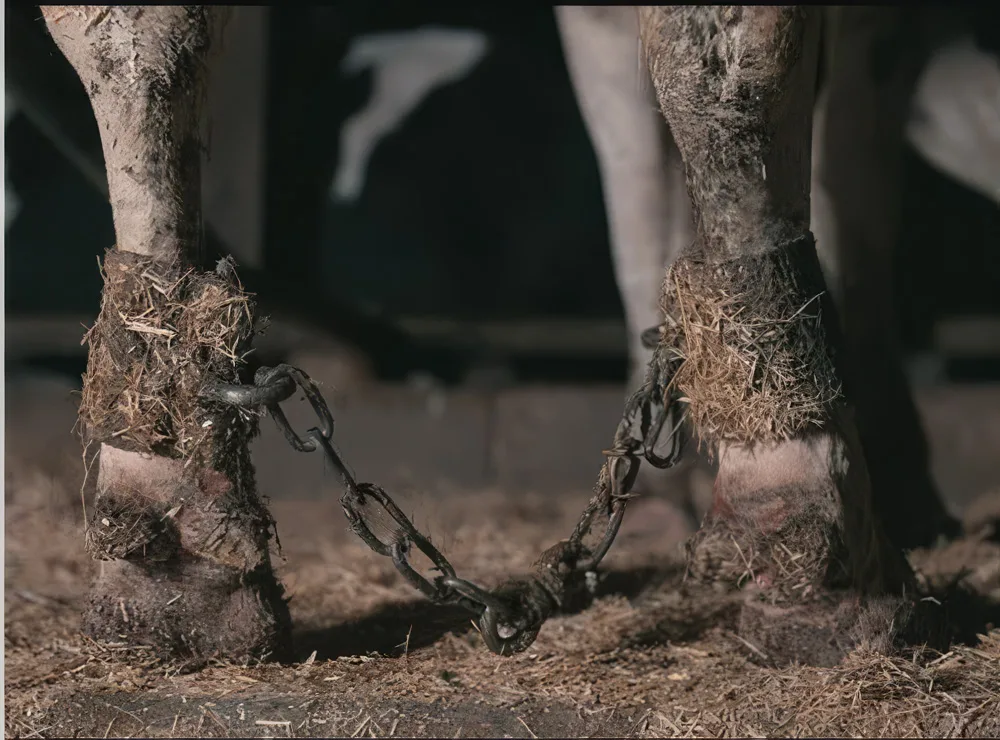
I will finish with that widely-shared image of cows in chains. I can’t speak to that particular cow, but cows do sometimes wear chains, and their presence isn’t necessarily sinister. They are used as a preventative measure to reduce damage and harm, usually when a cow has suffered pelvic nerve damage during calving. It takes a few days to recover – sometimes longer, but the norm is a few days – and unfortunately, not many farmers can talk cow … (although most of us do talk to our cows). You can’t tell her to take it steady while she’s walking around, and you definitely can’t tell her mates to give her some space. So the anti-splay restraints are used, giving them stability and preventing their legs from splaying.
That doesn’t tell us whether every use shown in this footage was appropriate – each case has to be judged on its circumstances – but the presence of a restraint is not, by itself, evidence of cruelty. Context is everything, always.
We cannot keep coming out with polite, correct PR statements, putting our heads in the sand and waiting for it to blow over until the next time.
We should take ownership and call out animal abuse and welfare issues. There is no place for it in our industry. If more training is required, or more staff to take the pressure off, then we must act, and recover the cost from the marketplace.
And the marketplace must respond, or one day they will run out of people to throw under the bus!