


Ever wondered what a Court Jester, Swallow, Throne, Angel and Cossacks have in common? Does a Ladder Handstand provide any clue? Probably not.
In fact they are just a few of the routines carried out by the world’s most famous motorcycle display team, the White Helmets, and are frequently performed backwards without a rider at the controls and the throttle stuck at the required speed. All things considered it’s nothing short of terrifying, but also about as balletic as riding a motorbike can be – as those that have seen their breathtaking annual displays at Dorset County Show will readily attest.
Based at Blandford Camp, the team of 30 volunteer soldiers from the Royal Corps of Signals tours Britain from April to September every year demonstrating not only their perfect command of their machines – classic 1970s Triumph T140s – but also their highly developed sense of timing and balance, not to mention discipline and no small degree of bravery, all personal qualities demanded of the modern Royal Signals soldier.
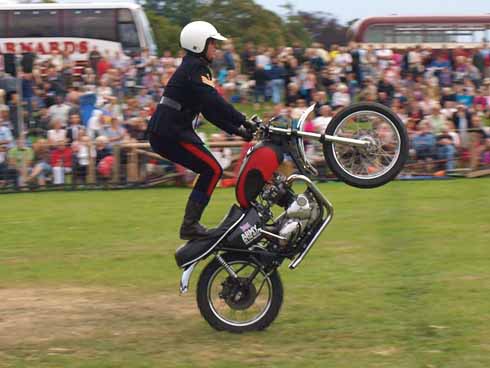
‘The lads are rightly very proud of what we do,’ says team leader Captain Richard Carr, ‘and they want people to see that, so as well as demonstrating what they can do there’s an important element of performance that comes into play. They tend to be natural showmen so they want the public to see the smartly dressed soldier on the heritage motorcycle in an open face helmet smiling and waving back to the crowd.’

Formalised in 1921, the team can trace its roots back to World War 1 and the very earliest Army motorcycle dispatch riders who would show off by performing tricks to amuse themselves and their comrades. It didn’t take long for that to become competitive. The Royal Signals is an offshoot of the Royal Engineers, which used horses for cable laying and other tasks, so races between engines measured in horsepower and actual horses were inevitable.
‘We used to perform with horses regularly but not so much nowadays – it introduces too many random factors. However, we have done some special events with the Household Cavalry display team, racing horses over a course of special challenges. They beat us a couple of years ago at the Royal Military Tournament, but we did it again earlier this year at their Open Day and we beat them – and on their own turf, so that was pretty special.
‘In the early days we had nicknames like the Red Devils and the Mad Helmets, but settled on the White Helmets because they decided to wear white helmets and dress in Blues – that’s the regulation Royal Corps of Signals No.1 Dress, so the same uniform they would wear if they were on public duty with the Corps.’
The blend of bravado and intense training is mixed with the banter and badinage that comes with trusting life and limb to other people. The only fear that can get in the way, they’ll tell you, is that of failure.
‘Everyone has to perform their first Fire Jump on their graduation day in front of the colonel and their families and friends,’ explains Captain Carr. ‘That’s their initiation if you like, the pinnacle of their training – they lose their eyebrows and trade in the black helmet they wear in training for a white helmet.
![The Fire Jump: it's the initiation if you like, the pinnacle of [trainees'] training – they lose their eyebrows and trade in the black helmet they wear in training for a white helmet](https://www.dorsetlife.co.uk/wp-content/uploads/2015/11/1115EdWhiteHelmets_-Fire-Jump-Graduation-Show-2015.jpg)
‘Doing it for the first time is nerve wracking, but not frightening because you know you can do it from all the training that’s gone before. You don’t want to mess it up and go through on your face though, not in front of people that know you and the guys on the team. So you have to do it with confidence and enjoy it.’
Just occasionally someone comes a cropper and few more memorably than when Declan Donnelly, half of ubiquitous TV double act Ant and Dec, dropped his bike in a Fire Jump and ended up in hospital in 2005.
‘They’d been training with us for a feature on their Saturday Night Takeaway show and they’d both done really well, but on the final day when the cameras rolled and they’d called ‘Action’ he saw the fire and panicked, which is a perfectly natural reaction, came off his bike and ended up in hospital. I think we were instrumental in them taking easier challenges after that.’
The White Helmets perform up to 50 shows a year, typically two shows a day over a two- or three-day weekend – and it doesn’t cost the taxpayer a penny. The team is entirely self-funding, it charges event organisers a fee for its services to pay for parts and labour, travel expenses and fuel costs. How much depends on the distance the team has to travel from its Blandford home – £1000 would cover a booking in the south of England, rising to £3000 for the north of Scotland.
‘People always ask about this – the only thing we don’t cover is the lads’ wages and fuel is the most expensive out-going we have, but we don’t have to make a profit so compared to what a top band would cost for a summer event we are very competitively priced as entertainment.’
The White Helmets also fulfils an important role in what the Army calls KAPE – Keeping the Army in the Public Eye.
‘There’s no direct recruiting, but we are seen as a useful recruitment and retention tool as an example of the opportunities that could be available to someone should they join the Army. For anyone who loves bikes like I do there really couldn’t be a better job.’
To join the team volunteers must have completed basic training and have three years’ service behind them. A tour of duty with the White Helmets lasts for three years before soldiers return to regular units. Three years later they are able to apply for a second tour with ‘carded’ positions (chief instructor, chief mechanic) invariably held by second termers.
‘The three-year turnaround means the most experienced third of the team leaves every year so it’s a part of your job to identify your successor. We’re very self-contained so not only do we maintain our own machines, we train each other and pass on the skills needed to keep the team at the top if its game.
‘I’ve got a manual on my desk that is a good fifty or sixty pages deep and in there are instructions for tricks, stunts and virtually everything it is possible to do on these bikes so although we do change and tweak displays to keep them fresh, if it’s not broke why fix it?’

Remarkably, never having ridden a motorcycle before is not a barrier to joining the White Helmets and Captain Carr’s successor, Captain John McLelland, had never even sat on a bike before his appointment. It seems riding a bike is treated the same as most skills a soldier learns after joining the Army, as something they would have gained no experience of in civilian life.
‘In some ways it’s better to take guys that don’t know how to ride so you can teach them from scratch and not have to un-teach bad habits learned over years of riding,’ says Captain Carr. ‘In the two week selection course we aren’t looking for the best riders but the ones with the greatest potential to be an asset to the team. So if someone learns quickly and develops well then they are far more likely to be taken on than someone who can already ride at speed.’
But what about when they leave and go out on the road on their own bikes; how do they control the urge to pull a wheelie, jump through fire, ride backwards, or steer with their feet?
‘That’s easy – if I drop my own bike I’ve got to pay for it!
‘The White Helmets is an extension of the skills required by the trade of dispatch riding. The avoidance skills you learn with the team alone make for safer riding in all circumstances, but we teach a level of awareness, of being able to focus on a wider field than simply what’s happening on your front tyre, to know what’s happening around you and to identify hazards. Then we teach you to do it backwards with no hands on the handlebars.’
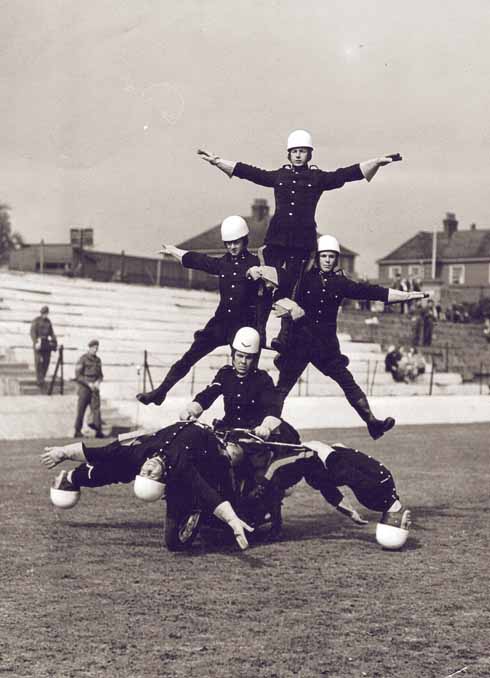
Captain Carr’s last outing with the White Helmets before he returns to a regular unit was at this year’s Dorset County Show and he makes no bones about it – he’s going to miss it: ‘Before anyone leaves we send the lads on a ‘Zero to Hero’ refresher course to brush up on their military skills so it’s not too much of a shock. In the team you’re away from your families most weekends and there’s a lot of travelling, but there’s a great team spirit and there’s no doubt about it you do feel part of something special.
Being back on the unit is good hard graft, but although it’s a lot of fun the White Helmets is not an easy ride by any means.’ ◗
Sponsors of motorcycles or team riders can enjoy private shows, signed memorabilia, corporate shows and private days with the team. For information call 01258 482365. ❱ www.whitehelmets.co.uk

Charlie Johnson Payne, aka Snaffles, was born in 1884; he was a bootmaker’s son and the fourth of eight children. From an early age his twin passions were horses and the military.
His initial attempt to join the Army in order to fight in the Boer War was thwarted as he was too young. In 1902, when he finally reached 18, he enlisted into the Royal Garrison Artillery where he learnt to ride but ill-health forced his departure in 1906. It was during this time that he also produced his first semi-caricature portraits.
He re-joined the Army at the outbreak of World War 1 but was soon invalided out after a very bad fall. Snaffles then took a job as a war artist; producing many works which reflected the horrors of trench warfare and life on the Western Front.
In the 1920s Snaffles gained a reputation as a sporting artist; particularly focusing on equine sports and, where possible, the military at play. His prints of ‘pigsticking’ in India in the late 1920s are some of his finest works.
Snaffles built an element of humour into his work and the captions to his subjects were often as important as the artwork. Our cover picture is no exception; the inscription reads “Remarkable close to the old busses ‘ead’ to let the shots go by (RK)”. The RK refers to Rudyard Kipling, another of Snaffles’ childhood influences. Indeed the quote is a slight twist on a line from a Kipling poem entitled ‘M.I.’ (Mounted Infantry of the Line); the line goes “Remarkable close to my ‘orse’s neck to let the shots go by”.
Snaffles died in 1967 aged 83 after a life as a true Victorian.