

 In his 1906 book, Highways and Byways in Dorset, Sir Frederick Treves views Wareham from the north and is clearly taken with the town, at least from afar: ‘Seen from a distance the town is most picturesque. A long green rampart rises sheer out of the meadow; at the foot of the slope is a stream edged by rushes and peopled by white ducks; over the top of the bank can be seen the roofs and chimneys of a town and the tower of a church. A causeway leads across the meadow to a gap in the wall – this is the North Gate, which opens upon the long street’.
This view would now require the observer to stand on the roundabout at the northern end of the bypass. Ignoring traffic and tarmac, much of that described by Treves is still evident. The impressive 9th-century defensive walls remain the dominating feature. There were ducks to be found in the river, although none of them was white.
Treves states that: ‘The whole of the town is within the walls. Indeed, so much has the little place shrunken that it occupies but a part of the area enclosed by the entrenchments. The rest of the space is filled up by gardens and orchards. The summit of the wall makes an excellent promenade, much affected by children at all times and by young men and maidens on high days and holidays. From the crown of the rampart it is possible to look down upon the few houses which venture near the battlements, upon potato plots, upon pig-styes and courtyards, flower gardens and paddocks with cows. Those who know the town say that the lanes between the gardens are old streets, and that there were once houses along Mill Lane, Bell Lane, and Howard’s Lane’.
It is more than 100 years since Treves made his observations regarding the diminutive size of Wareham and much has changed. Whilst it would be true to say that most of the expansion during the early part of the 20th century was confined by the ancient barriers that are the rivers and the walls, the gardens, orchards and paddocks that Treves saw have, largely, been replaced by houses. Wareham now not only fills its confines, it positively spills out and over them. The most obvious manifestation of this is the major expansion of the town to the west, the new ‘barrier’ being the bypass. There is no longer a Bell Lane, but ironically, the name given to a plot of land in the vicinity in Treves’s time – Bell’s Orchard – is now the road’s name.
Treves now gets another perspective, looking from the Wareham to Stoborough road: ‘On the south side of the town…the wall is replaced by the River Frome. The south gate, like the north, is approached by a causeway over the meadows. Athwart the stream is a grey bridge of five arches, built in 1775. There is generally one man at least fishing from the bridge, while others loll over the parapet watching their shadows on the gravelly bottom of the river, or gazing seawards at the white sails beating up Poole Harbour’.
Sadly, the five-arched bridge is no more, replaced in 1927 by a modern, wider counterpart. The decision caused an outcry as the bridge was known to have Norman origins and was considered an important historical artifact. Treves’s statement that the bridge was built in 1775 is wrong on two counts: first, the date was 1788 and secondly, this was actually a rebuild date, as the bridge was much older. The stone from the bridge was used to build a porch at Trigon, north-west of the town, where the 1788 date stone is now to be found.
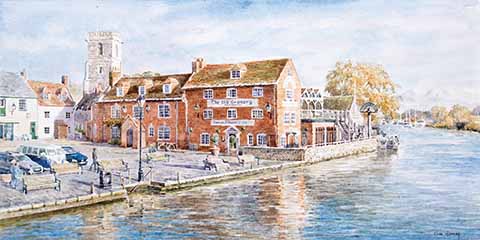
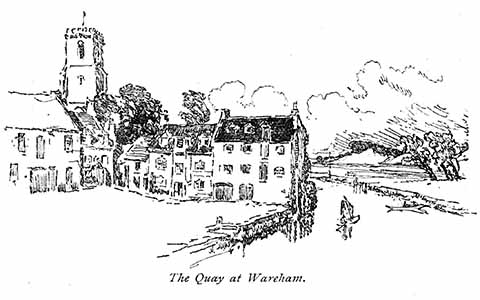
Crossing the bridge and entering the town, Treves notes: ‘By the bridge is the quay – a wide, capricious square – which was crowded and bustling when Wareham did trade with the world. It is now deserted, except for two boys who are fishing and a pedlar who has fallen asleep in the sun from the fatigue of watching them. By the river’s side, beyond the landing quay, are storehouses held up by determined buttresses as if at one time the walls were bursting with merchandise.’
The ‘capricious square’ is often busy these days; if it’s not a packed car park, it’s a market. Rarely is it deserted. The storehouses and their ‘determined buttresses’ are still there; thirty years ago they were in a state of disrepair and were saved by being converted into hotel rooms.
Treves could never resist a church and spends the rest of his time in Wareham enthusing over two prime examples: ‘Overlooking the quay is the fine Church of Lady St Mary. So near is it to the river that the reflection of its tower falls across the water. There is much of interest in the church besides the usual stone coffins and cross-legged effigies of knights in corroded armour. There are cryptic writings carved on the wall, which none can read aright; a leaden font belonging to Norman times, on each of whose six sides is a little featureless Apostle black with age; a Roman altar of doubtful repute, and a cresset stone or lamp with five holes, in which wicks floated on oil’.
The above paragraph by Treves is unusual not for what he says but for what he doesn’t say. Sir Frederick had a firm dislike of the Victorian inclination to ‘restore’ churches. Typically, whenever he came across such a church, he wasted no time in criticising the act as vandalism. It should be acknowledged that Lady St Mary, like many churches in the 19th century, was in a poor state of repair; the roof of the nave was in a precarious condition and work needed to be carried out urgently. Nevertheless, rather than conservation, the Victorians preferred rebuilding and in Lady St Mary’s case the entire nave was rebuilt at the same time as the roof was replaced. Even in 1842 this caused a good deal of controversy, as this was essentially a Saxon church with (as the excellent church guide states) ‘alterations and additions’.
The font referred to by Treves is one of only eleven remaining in the country and unique in that it is hexagonal in construction. Dating from the 11th century, the lead bowl with its carved figures sits on a Purbeck stone base of a hundred years later. The church guide shows that the cryptic writings have now largely been deciphered and archaeological digs carried out over the last few years have uncovered many items of interest, some of which are now displayed within the church. The Roman altar ‘of doubtful repute’ is a mystery – there is no evidence of an altar of this period and later editions of Highways and Byways had removed the statement entirely.
Wareham’s other ecclesiastical gem is St Martin’s-on-the-Walls. Treves is enamoured: ‘Of the eight churches of the old town, but three remain. One is used as a school-room, one is the Lady St Mary Church, and the third is a queer, ivy-covered little chapel on the walls. This last-named is the Church of St Martin, in whose bare nave the voice of the preacher has not been heard for 170 years. The place is weird, empty, vault-like, and eerie with great age. There are traces of unremembered paintings on the wall, sand on the floor, heavy roof timbers hung with spider’s webs and grey with long-faded mould. The chancel is spanned by a Norman arch, while in the tower—with its single bell—is a Saxon window, and in the body of the chapel are other traces of pre-Norman days. The last time that the folk of Wareham came to the chapel-on-the-wall was to find a sanctuary there from the great fire. In this ghostly, dusty, vacant place they camped for weeks, while the embers in the streets grew black’.
By Treves’s time Holy Trinity had ceased to be used as a school-room, as it was moved to another site in 1885. This is strange as Treves would have known Wareham well – could it be that he wasn’t aware that the school had moved? Until quite recently the church was the Tourist Information Centre, and now it functions as a community café.
It is satisfying to be able to state that things have improved for the church of St Martin’s-on-the-Walls. The church was repaired and re-dedicated in 1936 and further extensive repair work was carried out during the 1990s, when the place was also re-furnished. Services are now held regularly throughout the year. Many people visit the church to see Eric Kennington’s striking effigy of T E Lawrence. Intended for a cathedral setting, it none the less sits well in the north aisle. Kennington was one of the six pallbearers at Lawrence’s funeral at Moreton in 1935.
Treves was impressed by Wareham and would be still. It has more than its fair share of attractions in two magnificent churches, ancient defensive walls, well worth walking upon, a riverside walk and a museum… it also has some excellent drinking establishments.
The author would like to thank Lillian Ladle and the helpful people in Lady St Mary church.