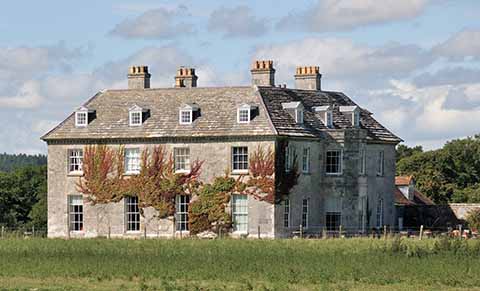
 A DIARY written two centuries ago provides an insight into how the landed gentry spent their Christmases in pre-Victorian Dorset. It also sheds light on the social unrest in the run-up to the trial of the Tolpuddle Martyrs. The diary, covering the years 1779 to 1845, was written by Mary Frampton, sister of James Frampton of Moreton House, who was to play a leading role in the arrest and conviction of the six farm labourers whose names are etched into trades union history. And it’s clear that Christmas 1830 was not your average festive season. In November and December that year, Mary speaks of riots and uprisings by large groups of men demanding higher wages and bent on destroying the labour-saving threshing machines that were threatening their jobs. By early December, the windows and doors of Moreton House were boarded up and Dorset Militia soldiers stood guard.
Mary’s account of Christmas reflects the unusual circumstances. ‘Our Christmas passed with a large family party at Moreton,’ she writes. ‘The house was unbarred and unblockaded with the exception of one large window on the staircase.’ Carol singers from Mr Frampton’s parishes ‘ushered in Christmas Eve and Christmas Morn as usual’.
Of the Christmas dinner arrangements, Mary writes: ‘The peacock in full plumage, with its fiery mouth, was placed on the dinner-table with, of course, the boar’s head. The immense candles were well covered with laurel, the hare appeared with the red herring astride on its back; and the wassail bowl and lamb’s wool were not inferior to former years.’
Christmas aside, this was a time of immense social unrest both in London, where the Prime Minister, the Duke of Wellington, was stoned, and in the countryside. The rural unrest began in Kent in October, when corn stacks and barns were set alight, and quickly spread to other counties, where ‘riotous mobs’ destroyed ‘machinery used in husbandry, paper mills etc’ and surrounded gentlemen’s houses, ‘extorting money and demanding an increase in wages’. The ‘risings’ reached Dorset on 22 November, and Mr Portman [of Bryanston] immediately promised to increase his labourers’ wages, ‘and by doing this without concert with other gentlemen, greatly increased their difficulties.’
Mary writes: ‘My brother, Frampton, harangued the people at Bere Regis, and argued with them on the impropriety of their conduct, refusing to concede to their demands while asked with menaces. This spirited conduct caused him to be very unpopular, and threats were issued against him and his house.’
On 30 November, James Frampton joined 150 farmers (all appointed special constables) to confront a rising by villagers at Winfrith, Wool and Lulworth. Mary continues: ‘The mob, urged on from behind hedges etc by women and children, advanced rather respectfully, and with their hats in their hands, to demand increase of wages, but would not listen to the request that they would disperse. The Riot Act was read. They still urged forwards, and came up close to Mr Frampton’s horse.’
Frampton collared one man, but he escaped by slipping out of his smock-frock. As news arrived that another ‘mob’ was advancing from Lulworth, three men were arrested and committed to Dorchester Gaol. When James Frampton and his son, Henry, arrived back at Moreton, they described the mob as ‘being in general very fine-looking young men and particularly well dressed, as if they had put on their best clothes for the occasion’.
In early December, reports reached Moreton almost hourly of mobs assembling to break threshing machines, demand higher wages and ‘extort’ money. It was at this point that it was decided to board up Moreton House’s doors and windows.
Dorchester was ‘well patrolled’ and saw no uprisings. Fordington people helped to extinguish the flames after two ricks a mile away were fired. Lancers and dragoons arrived, the lancers looking ‘worn down by the riots in Wiltshire’. On 10 January 1831, a Special Commission, set up to investigate riots and fires across the country, reached Dorchester. Mary reports that no-one in Dorset was sentenced to death, but six or seven were transported for life. The same week, four or five fires were started across the county and threatening letters sent to farmers. Stinsford’s ‘excellent clergyman’, Mr Murray, had a threatening letter, written on ‘dirty and rumpled paper’, slipped into his pocket.
Mary reports no further unrest in Dorset until 19-20 October 1831, when a ‘considerable mob’ attacked Sherborne Castle, breaking ‘every pane of glass’, trying to force the gates to the court and forcing Lord Digby’s guests to abandon a ‘round game’ they were playing and flee. When troops arrived, the mob switched their aggression to the town centre, breaking more windows. After that, the riots appear to have petered out, at least in Dorset, as does Mary’s diary, which contains no entries at all between 1834 and 1837 – the period during which the Tolpuddle Martyrs were tried, transported, pardoned and brought home.

The best of Dorset in words and pictures