

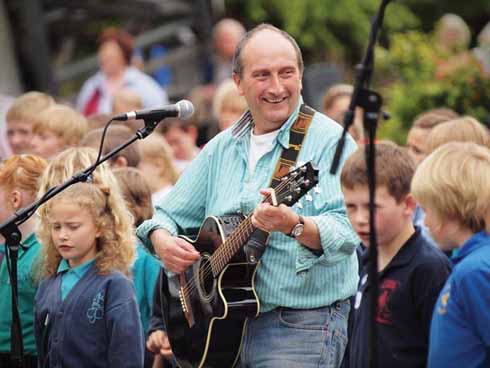
From the heights of the classical repertoire, to the most humble nursery song, it’s all music to Andy Baker’s ears. A graduate of the Royal Academy of Music who cut his teeth playing bass in a rhythm and blues band on the London pub rock circuit of the 1970s, for the last 18 years he has worked with modest enthusiasm as Bournemouth Symphony Orchestra’s community musician, taking music and music making to parts it might not otherwise reach.
From playgrounds and day centres to a memorial concert in Normandy and a Dorset hilltop chapel, Andy makes it his mission to spread music wherever he can. Not for him the stuffy world of the highbrow musical autocrat, he views the orchestra as a democratic resource for the whole community to tap in to: ‘Music is a universal language,’ he explains. ‘I love this job because one day I’m playing in one of the world’s finest orchestras, the next I’m working in a recording session, then I’m with a bunch of three-year-old pre-schoolers, followed by a session at Alderney Hospital or with primary pupils at Heathlands School in West Howe. Then I could be playing country and western. The breadth of music I get to play is astonishing and that’s something I am incredibly joyous about.
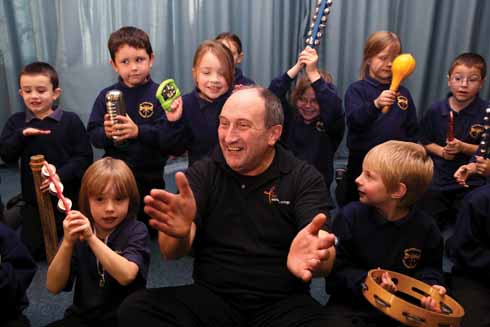
‘Early on I had to make a choice between rock ’n’ roll and the Royal Academy of Music. I thought I’d take the formal training route, but it was very different in those days, it was like rock music didn’t exist and even though John Dankworth and Cleo Laine were tutors there, a lot of them didn’t really like to talk about jazz: that was music that happened after half past nine at night played by people who didn’t wear socks. ‘It’s not like that any more I’m pleased to say.’
Andy’s musical CV includes stints with the London Festival Ballet Orchestra and principal bass with the BBC Northern Ireland Orchestra as well as playing and recording with musicians such as James Galway, Marianne Faithfull, John Surman, Abdullah Ibrahim, Jimmy Webb, Clannad, even Westlife – he played on their number one hit Swear It Again. He joined Bournemouth Sinfonietta in 1978 and was nominated for a prestigious Royal Philharmonic Prize for his work with inmates at Portland’s Verne Prison in 1998.
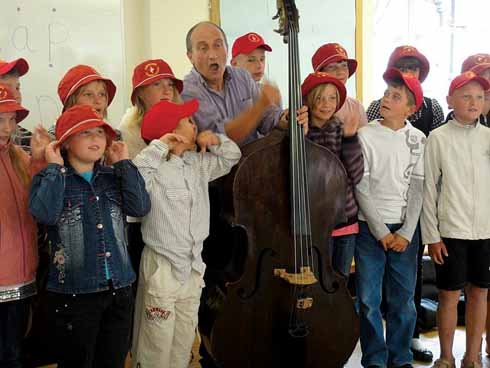
It’s nothing if not varied and the common thread to it all is music: ‘Picasso used to talk about children having this wonderful creativity that was gradually channeled out of them by life. I’m not saying they shouldn’t go to school, but when you work with pre-schoolers you can see it there so all we try to do is tap back into that.
‘I’ve been doing some work on some string parts that David Bedford [the late composer, conductor and string arranger] gave me. He arranged the strings for the Madness hit Our House and he gave me the parts he wrote, which have been doctored so they can all be played on open strings or first finger position. When the kids get that going it sounds amazing and they love it.
‘It’s not just about the playing it’s about the boost their confidence gets and the fact they can relate to an adult that isn’t a teacher or family or someone in authority. But I’ll let you into a secret; if I want a room of noisy kids to shut up I just play the two notes from Jaws. E and F, two notes a semitone apart. Works every time – thank goodness for John Williams!’

For all the symphony orchestra concerts, hit records, top recording sessions and midnight jams, the work Andy is most proud of happens where arguably fewest hear it – with dementia patients at Alderney Hospital.
‘They don’t hesitate to tell you when they’re not in the mood, but at other times they are so receptive to music,’ he says. ‘Dementia is such a cruel condition and the work at Alderney has given me real insight into what must be the chaos of their minds. Music speaks to something very deep inside us, it’s often the last thing to go. It has a wonderful way of mellowing them as it seems to play directly to their memories.
‘I also have the greatest respect and admiration for the people that work with the patients because they get pushed to the absolute limit – they’re incredible. The effect of music is tangible. I’m told that playing music to people with dementia in the twilight hours is a great way to settle them and could save something like 28 per cent of their drugs bill. That is very powerful.’
Last year Andy worked with the Bournemouth University Dementia Institute (BUDI) helping to form an orchestra for people with dementia and their carers. ‘They are leading experts in this field and this is something they have wanted to do for a long time,’ he says, ‘to study how music affects the brain. So I’ll put together a backbone orchestra and we’ll invite people with dementia to play with us. It’s a tall order, but it can be done. I reconnected with a friend of mine I was at the Academy with that I hadn’t seen for years and found he had dementia. He was only 56, but when he picked up his trumpet his old self would come back – put it down and he’d get confused.
‘So this is really cutting edge stuff that’s going on and it’s happening right there in Dorset. What a privilege. When people ask why I do this, that’s the reason.’
With his diary full and no shortage of schemes for the coming months, I wonder if Andy has an idle moment in which to fantasise about a dream concert. It turns out he does.
‘The idea of different types of music being brought together really interests me – like Quincy Jones’s Soulful Celebration version of The Messiah which brings Handel’s music to hip hop. I’d love the BSO to play Stevie Wonder’s Sir Duke, it’s like a Strauss tone poem, or a BSO concert with a big gospel choir – Jon Anderson’s song State of Independence is crying out for that treatment – then some Vaughan Williams and maybe something baroque, simple music but played with joy.’ ◗