The craftsman’s stamp
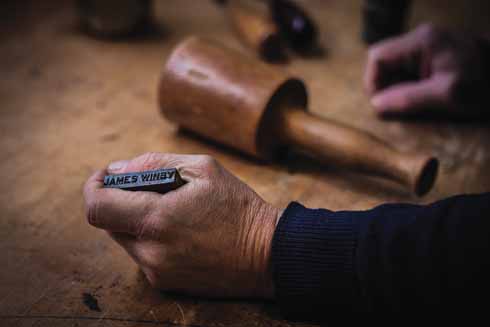
James Winby’s barn workshop is appropriately hushed by ancient woodland on Cranborne Chase. It is quite a traditional place where each team member has his own workbench and tools. It is divided between two areas: one where the handwork is executed and another where the machinery lives. The machinery is used as little as possible, mostly to transform particularly knobbly or difficult pieces of timber. Within the barn, the office is a sort of crow’s nest, overlooking the workshop floor. Muffled clunks and murmured words float upwards from craftsmen Ed and Jethro, but mostly an air of quiet concentration reigns. Each piece is worked on from start to finish by a single craftsman. Today, it is all hands on deck for a set of fittings for an ultra-modern flat in Kings Cross, London. Clearly, the business is flourishing.
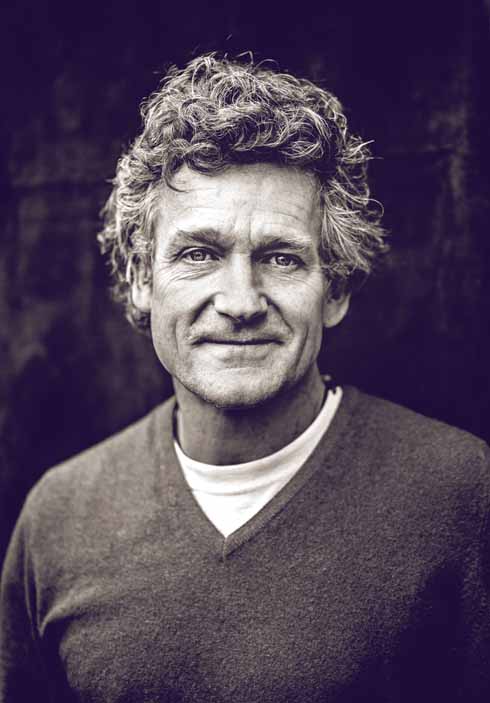
James Winby
After art college, James started a formal apprenticeship with the Arts and Crafts revivalist, Alan Peters, ‘Alan was great – terribly strict of course – but he kept me alive and I beavered away.’ The break came with a visit in 1992 from a Japanese itinerant craftsman. ‘This craftsman wrote a letter on an old typewriter to Alan in very bad English. He said that he had started up a workshop in Kobe, Japan, and could Alan send somebody to help him. I duly went. I only had a one-way ticket and naïvely believed that I would only be there for six months.’
It would be three years before he returned. Alan was alone with the maker, just outside the city of Kobe. ‘Nobody spoke any English and I was mute for the first few months. Gradually I started speaking Japanese. He was well-connected and introduced me to a huge array of artists; calligraphers, ceramicists, lacquer artists, wood-carvers. It’s always nice to be open to opportunities; I would never have gone to Japan if it hadn’t been for that craftsman’s letter.’
After those three years of learning techniques and experimenting, James moved back to London in 1995, briefly stopped making furniture and started building props for the film set of Emma, starring Gwyneth Paltrow. ‘By chance, one of the set designers I worked with on Emma is actually the woman who commissioned me for the King’s Cross job; life always seems to go around in funny circles.’
After the brief spell with film sets, James started up his own workshops in London, but by 1999, with family arriving, James and his wife decided that it was the right time to settle in Dorset, somewhere that James had always admired. ‘What’s not to like? Dorset’s got everything. It was quite an important thing for me when we moved to Pentridge that my new address had “Dorset” in it. It’s such a creative hub – perfectly placed. I think that the counties closest to London are too easily pulled into the capital’s mentality of money, money, money.’
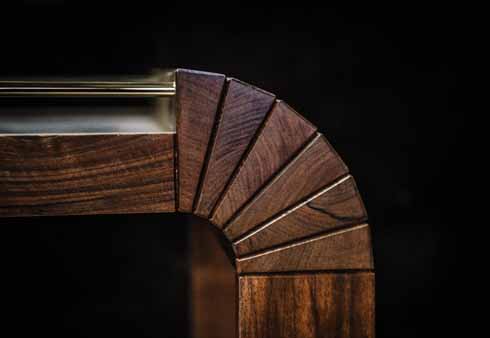
A beautiful Art Deco-style side table instigated by a visit to the Peckham Lido
By what James calls ‘another funny coincidence’, while setting up a workshop in Sixpenny Handley, he met the late William Gronow-Davies, the owner of the Rushmore Estate, who encouraged James to leave Sixpenny Handley and come to the estate farm to set up a workshop in the disused barns.
‘I think that wood holds something deep within our psyche, humans having used it for millennia. The beauty of timber is that a lot of the work is done for you already – providing you let the wood be the star of the show. It’s a great medium to work with and it’s renewable, especially in the way that we use it, which is to make things to last.’ Time matters in James’s work, from the time spent over design to the time making it and interacting with the client throughout. ‘Being a furniture-maker means that you are going against throwaway culture, always competing against it. We mainly use oak and walnut. Any exotic species such as mahogany is thoroughly checked for certification; the industry has become aware of illegal logging and cleaned up its act since the time I started work. Predominantly we use natural waxes and oils to finish the wood,’ James says, before adding that recently, ‘we’ve built a separate spray shop, meaning that everything we do can be to spec, including paint finishes.
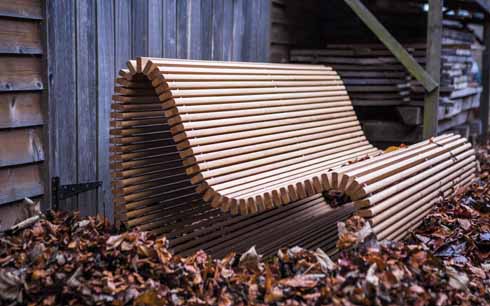
James’s Japanese inspired sushi roll mat bench outside the barn workshop
‘When people ask me, “What sort of furniture do you make?” I say it is simply contemporary. Modern joinery techniques haven’t changed much throughout the years. Wood moves with the seasons and every now and then designers approach us with designs that don’t take that into account. One of the first things you have to appreciate is that you’re working with something that has a life of its own. I can’t imagine there are any woodworkers who can confidently say they’ve seen it all before, because you don’t.’
Sometimes the Japanese influence is as unexpected as it is obvious, as with a one-off sushi roll mat inspired bench. The perfume of the wood is unexpected and tangy, mixing with the dead leaves on the path. ‘The difficulty was coming up with something sturdy enough that wouldn’t wobble around,’ says James. ‘A great deal of thought went into this idea, involving tiny steel pegs that are barely visible, meaning the design weightlessly holds its structure.
‘The projects I like most are the ones where people give me complete freedom. Because I have always adored the sea, I would love to completely equip some fabulous modern house on the clifftops. When I am not making, I balance my creative side with activity: cross-country running or climbing my favourite routes along Winspit and Dancing Ledge.’
James Winby can be contacted on 01725 516454, by email to [email protected] or online at http://winby.co.uk/