

When I learned that 2017 marked the 200th anniversary of the first archaeological dig (or of the first report on the dig) at Shaftesbury’s Abbey ruins, I came across a Regency ‘Tony Robinson’ figure.
He was scurrying energetically around, fingers in various pies, including helping to revise the Shaftesbury section of Hutchins’ History of Dorset. According to author John Chandler in his excellent book on the nunnery, A Higher Reality, Charles Bowles (1766-1837) ‘moved easily’ in Shaftesbury’s gentry circles and was the brother of the ‘minor but prolific’ poet William Lisle Bowles.
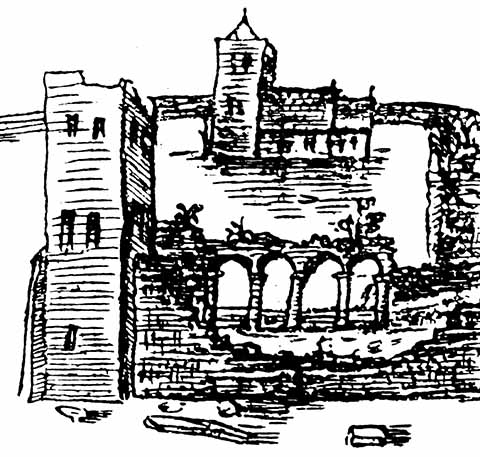
There were no industrial excavators, nor professors of archaeology, nor an army of students itching to dirty their fingers in the Shaftesbury soil to help Charles when he set out to uncover the Saxon nunnery’s long-buried secrets.
Charles’s workforce was modest in the extreme: ‘Having obtained permission from John Dyneley, esq., the proprietor of the site of the late Abbey of Shaftesbury, to make any searches I might think proper,’ he wrote in the Gentleman’s Magazine, ‘I employed a workman to dig there.’
By 1816, almost 280 years after the nuns were led mournfully away by Henry VIII’s hatchet men, six feet of topsoil had accumulated on the site of the old Abbey church. After much digging, Charles’s workman finally hit the floor: ‘It is composed,’ Charles wrote, ‘of what might be called Roman tile, having gryphons, dragons, greyhounds, and other animals, burnt in the bricks or tiles, interspersed with the arms of Stourton and Bonham painted in shields, similarly burnt in…. The bricks or tiles are about four inches square.’ Charles supplied the Gentleman’s Magazine with a drawing of one of these bricks, bearing the arms of Bonham, ‘done, as I suppose, when the Abbess Bonham presided – her Abbacy commenced in 1462; she succeeded the Abbess Stourton.’
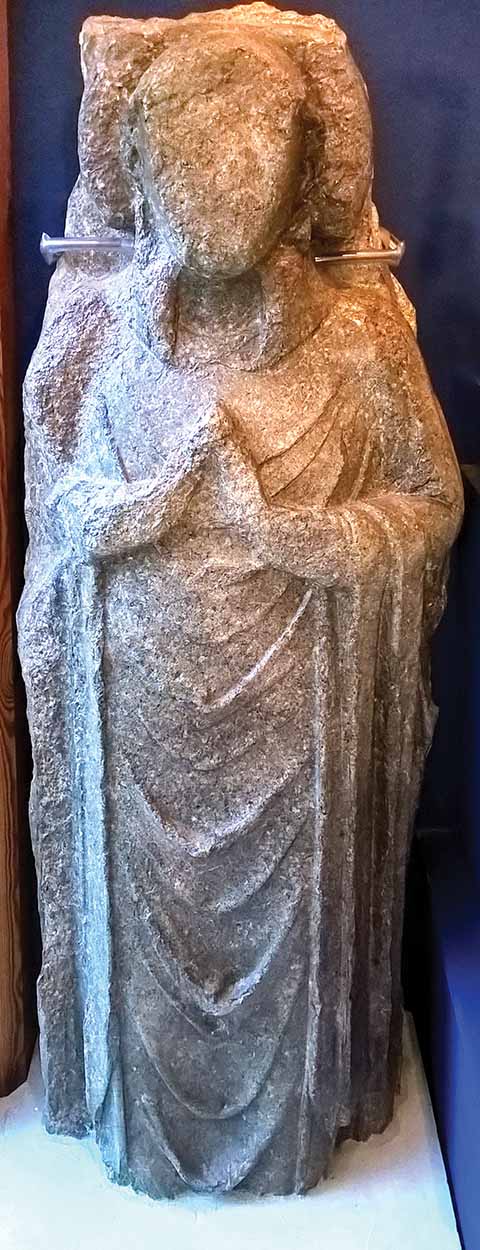
Charles and his man also uncovered ‘many mutilated monuments, chiefly of Purbeck marble’. ‘It seems as if those into whose hands the Abbey materials fell were anxious that the names of the dead should be concealed, as the face of the figure is destroyed, as well as the legend which once surrounded it. I have met with several other monuments but not one with an inscription. Remains of the billety [sic] mouldings, of massive pillars, of the Purbeck slender marble shafts, everywhere dispersed underground, convince me that this once grand pile of buildings was composed of Saxon, Norman and the modern [Gothic] architecture or pointed arch.’
As far as we know, Bowles left no plan of his excavation and probably gave away most of his finds as souvenirs. The Purbeck marble effigy with the disfigured face survives in the Abbey Museum but everything else seems to have disappeared. Some finds may have ended up in Tout Hill, the steep incline from Enmore Green to Shaftesbury, which once formed one of the most challenging sections of the from London to West Country coach road. In 1826, an architectural historian reported that some monumental slabs and sepulchral effigies from the Abbey could be found in Tout Hill’s stone wall. It is surely no coincidence that in 1817 – the very year when Charles filed his report – this wall was rebuilt as part of a scheme to widen and realign Tout Hill.
More than forty years passed before the Abbey’s next brush with archaeology, an event inspired by interest from across the Wiltshire border. As Chandler aptly puts it, it was with ‘something of a missionary zeal’ that Wiltshire Archaeological and Natural History Society held their 1861 AGM in Shaftesbury, repeatedly urging their hosts to set up a similar club in Dorset. Although it was 1875 before this ambition bore fruit, Shaftesbury vicar James Reynolds did arrange an archaeological treat for the 1861 visitors, unveiling ‘a garden in which there were evident traces of foundations a few feet beneath the surface’. The star find was the skeleton of a man – presumed to be a priest attached to the nunnery – complete with pewter chalice and the remains of his wooden coffin. More digging followed in 1862 before the site was again backfilled until 1902-04, when a three-year excavation revealed more of the Abbey church’s east end, including the three Cs – crypt, choir and cloister.
Following a further period of neglect, the site became a scheduled ancient monument in 1924. And then came the mother superior of all Shaftesbury finds. In January 1931, owner’s son John Wilson Claridge and his gardener were clearing a corner of the north transept when they stumbled upon a lead casket hidden behind a large stone. It contained the skull and half the skeleton of a young man. Claridge believed these were the remains of Edward the Martyr, hidden in haste by the last nuns before they were ushered away in 1539. The teenaged King Edward was allegedly murdered at Corfe (Castle) in 978 by his step-mother, who had ambitions for her own son. His shrine became a magnet to pilgrims for centuries while many of his bones were lent to other monasteries – a fact which would explain why only half a skeleton remained. Even these bones controversially left Shaftesbury after the site changed hands in 1951. Despite legal attempts to have them returned, they were eventually re-homed – via a bank vault – at a Russian Orthodox shrine in Surrey.
Roger Guttridge’s book Shaftesbury Through Time will be published by Amberley in March 2018.