


Of all the characters who emerge from the annals of Dorset’s past, my ultimate favourite is Henry Hastings, the rough-and-ready village squire of Woodlands, near Verwood, 400 years ago. It’s not his contribution to the nation’s wealth, security or culture that attracts me: apart from generously sharing his DNA and single-handedly swelling the local population, there was none. What interests me are his sporting lifestyle and his womanising, both of which are legendary. Not that either did him much harm, as he lived to be 100 (or possibly 90, depending on which source you believe; but what’s a decade between 17th-century seniors?).
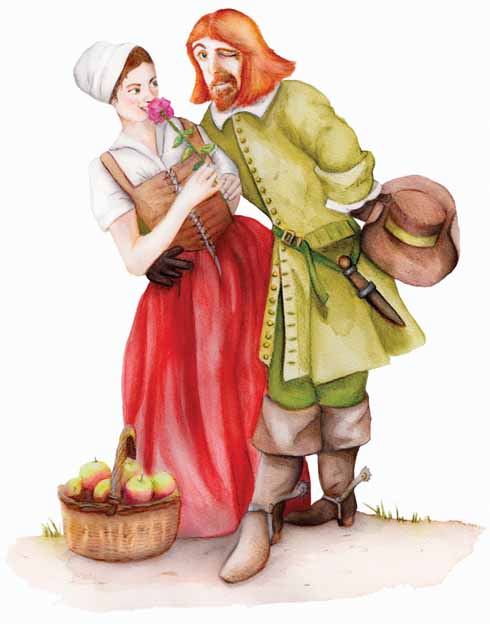
Not that Henry Hastings was an average kind of OAP. Born in 1551 (or perhaps 1561), he was of fairly noble birth, being the second son of George Hastings, the fourth Earl of Huntingdon. He became Lord of the Manor of Woodlands through his marriage to the heiress Dorothy Willoughby. His neighbour the first Earl of Shaftesbury, who lived at nearby Wimborne St Giles, described him as ‘low, very strong and very active, of a reddish flaxen hair’. ‘His clothes were always green cloth and never worth, when new, £5. His house was perfectly of the old fashion, in the midst of a large park well stocked with deer; and near the house rabbits for his kitchen; many fishponds; great store of wood and timber.’
The scope of Henry’s sporting activities was limitless. ‘He kept all manner of sport hounds, that ran buck, fox, hare, otter and badger, and hawks long- and short-winged. He had all sorts of nets for fish. He had a walk in the New Forest and the manor of Christchurch; this last supplied him with red deer, sea and river fish.’
According to Shaftesbury, Hastings spent virtually all his time hunting, shooting, hawking and fishing, except the time that he ‘borrowed to caress his neighbours’ wives and daughters’. In this activity, Henry was not especially choosy, but he did have his preferences, favouring ‘younger women of the lower classes’, preferably younger than forty. It was said that there was no young woman of the status of a yeoman farmer’s wife or lower ‘but it was her own fault if he was not intimately acquainted with her’. Part of Henry’s strategy was to butter up the women’s menfolk. He spoke kindly to their husbands, brothers and fathers, inviting them to his house and offering them ‘beef, pudding and small beer in great plenty’.
Henry may have been a great seducer and country sportsman but his housekeeping standards left a little to be desired. ‘The great hall was strewed with marrow-bones, full of hawks’ perches, hounds, spaniels and terriers,’ Lord Shaftesbury said. ‘The upper side of the hall hung with fox-skins of this and the last year’s killings; here and there a pole-cat intermixed; guns and keepers’ and hunters’ poles in great abundance.’
More dogs could be found in the parlour, where most of the great chairs were usually occupied by litters of cats, who were ‘not to be disturbed’. Some of the cats invariably attended their master at dinner and he kept a ‘little white stick that he might defend such meat that he had no mind to part with to them’.
The windows in the large parlour were littered with bows, arrows and other equipment, while the corners of the room were ‘full of the best-chosen hunting or hawking poles’. At one end of the parlour stood Henry’s oyster table, which was well used, as he ate Poole oysters twice a day throughout the year. At the other end were two tables and a desk on which sat a Bible and the Book of Martyrs. On the tables were hawks’ hoods, bells and other paraphernalia and two or three old hats with the crowns pushed in to hold ten or a dozen pheasant eggs. Nearby was a drinks closet stocked with wine and beer, although the booze was strictly rationed, as Henry never permitted excessive drinking by himself or his guests.
Lord Shaftesbury added: ‘He was well natured, but soon angry, calling his servants bastards and cuckoldy knaves, in one of which he often spoke truth, and sometimes in both. He lived to be 100 and never lost his eyesight but always wrote and read without spectacles and got on horseback without help. Until past four score, he rode to the death of a stag as well as any.’
Henry’s long-suffering first wife, Dorothy, second daughter and co-heiress of Sir Francis Willoughby, the builder of Wollaton, Nottinghamshire, died in 1638, twelve years before her husband. Within six months of her passing, Henry settled part of his estate on Anne Langton, of Woodlands, the unmarried daughter of William Langton. They subsequently married but when Henry died, he was buried alongside Dorothy at the old Horton church. Their son, Sir George Hastings, joined them there after his death in 1657. There is no mention of Anne in the epitaph.
If Henry left a legacy, it was in the number of children he fathered. How many of us with Dorset ancestors could count him among them if we did but know? ◗