

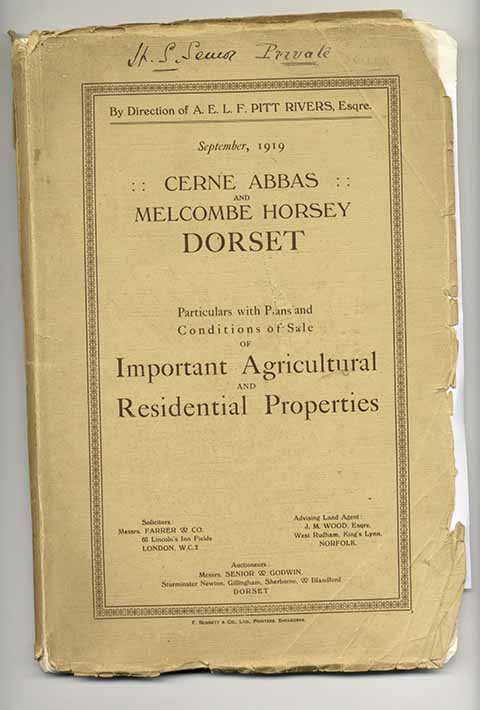
ON 24 SEPTEMBER 1919, a large crowd gathered at Dorchester Town Hall for what has rightly been dubbed Cerne Abbas’s ‘sale of the century’. On offer was almost the entire village – farms and farmland, houses and cottages, shops and business premises, organised as 73 auction lots along with four lots at nearby Melcombe Horsey. All were being sold for Alexander Pitt-Rivers, whose family had owned Cerne since 1705.
Despite the scale of the sale, Cerne represented a small proportion of the Pitt-Rivers land holdings, which also included the Rushmore Estate on Cranborne Chase and much property at Hinton St Mary, Okeford Fitzpaine, Burton Bradstock and elsewhere. Anthony Pitt-Rivers of Hinton St Mary, grandson of Alexander, explains that the main purpose of the auction was to ‘keep the show on the road’. Labour shortages following World War 1 and difficulty in finding tenants meant that Cerne was producing limited income. A letter from the Pitt-Rivers agent adds that ‘What we really want the money for is death duties, which would be invested in Victory Bonds’ – implying that this was in anticipation of duties that would be incurred whenever Alexander died.
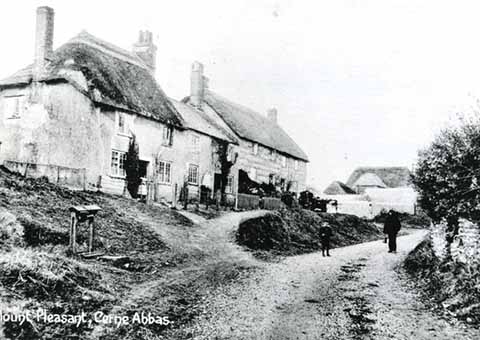
In stark contrast to the attractive Cerne Abbas of today, the village 100 years ago was in a sorry state following decades of decline and depopulation. Despite the auctioneers’ glowing descriptions of the properties on offer, many were in a poor condition. Author F J Harvey Darton, who visited some of the cottages before attending the auction, noted that there were ‘holes in almost every ceiling’ while ‘most of the walls were perishing’ and ‘slugs of the Giant’s kin were in many rooms’. He also found Abbey Farm ‘shut and deserted, the lovely orchard behind it many feet deep in grass and nettles, the little fabric of beauty in the gateway and the oriel window in the barn losing its mortar and drawing still nearer to final decay’.
Just thirteen years earlier, Sir Frederick Treves had reported grass growing in Cerne’s streets, deserted houses with ‘boarded up windows’ or ‘falling into listless ruin’, empty barns, ‘gates falling off their hinges and doorways grown up with weeds’. ‘Sad to say, Cerne Abbas is dying,’ added Treves in Highways and Byways of Dorset. Another report claimed that pigs roamed the ground floor of some cottages.
There was no reference to pigs, slugs or structural dereliction when H S Senior of auctioneers Senior & Godwin raised his gavel at Dorchester Town Hall. On the contrary, his catalogue was peppered with flattering adjectives to describe the various properties, including ‘commodious’, ‘comfortable’, ‘pretty’, ‘attractive’, ‘roomy’, ‘capital’, ‘compact’ and ‘well-constructed’. In The Marches of Wessex, F J Harvey Darton describes Mr Senior as an ‘austere man with a little white pointed beard and a monotonous voice’, which repeatedly asked with barely an inflexion: ‘Any advance?’ Senior’s audience comprised mostly farmers with a ‘sprinkling of gentry and humbler folk, and a few obvious agents – a gathering huge by the side of the coteries of Sotheby’s or Christie’s’. The audience betrayed a ‘subdued undercurrent of feeling which could not be mistaken: it broke out in cheers when a tenant bid successfully.’
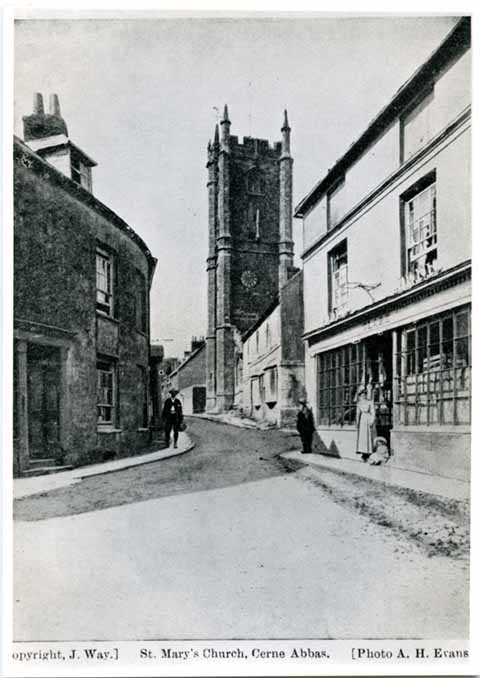
The star lot was lot number 1 – the unoccupied Abbey House complete with the ‘Guest House, fine old Western Gate House of the Benedictine Abbey’ and the Abbey site. According to the catalogue, this 196-acre lot was to include ‘Giant Hill with its sculpted hill figure’, but Mr Pitt-Rivers removed the Cerne Giant from the auction at the eleventh hour and instead donated it to the National Trust the following year. The Trust plans to mark the centenary of that acquisition during 2020.
The successful bidder for Abbey House was Joseph Kelleway Rolls, who had previously farmed at Manor Farm, Burton Bradstock. He paid £7600 for a lot that also included two tenanted cottages now known as 15 and 17 Abbey Street. Rolls was one of the busier bidders – he also bought Alton Lane Farm for £2000, Yelcombe Bottom (which included two cottages, a lime kiln, arable fields and pasture) for £3400 and two areas of pasture known as Butts for £420 and £300.
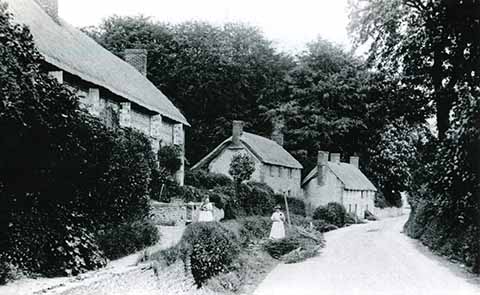
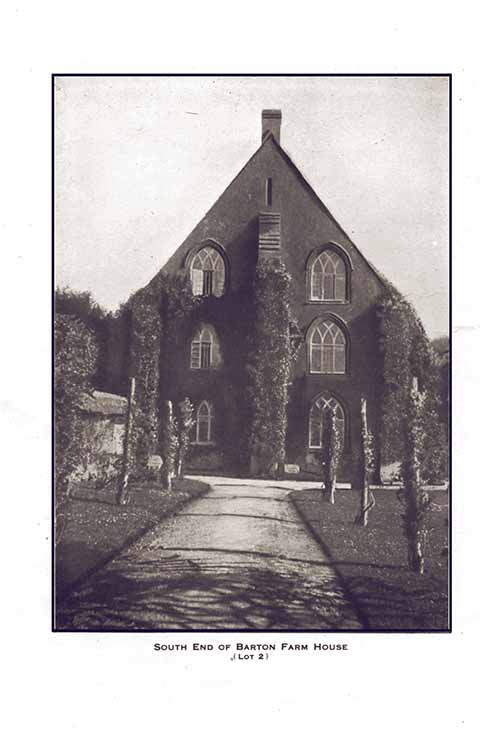
The only lot that attracted a greater price than Abbey House was Barton Farm (lot 2), which as well as the Farm House included the Dairy House, fourteen cottages, various farm buildings and 822 acres of ‘fertile water meadow, sound pasture and arable lands’. Sitting tenant Joseph Sprake, a respected farmer, paid £12,500 for the freehold as well as £2850 for Cerne Park Farm, £700 for ten acres of pasture called Three-Corner Ground and £540 for seven acres of ‘rich meadow and pasture’.
Many of the lots included shops and other business premises, providing an insight into the rural economy a century ago and earlier. Lot 14, a house with 79 acres of ‘well-watered dairy and arable’, was known as the ‘Glove Premises’, reflecting its early 19th-century use as a glove factory and later as the Glove Inn. Lot 19, described as the ‘Double Cottage’ in Back Lane, included the buildings and yard of a former tannery that had ceased trading in the late 19th century.
Shops featured in the auction included butcher’s and baker’s in Duck Street, which sold for £220 and £170 respectively; an ironmonger’s on the corner of Duck Street, called a ‘Valuable Corner Shop’ in 1919, which made £350; a stationer’s described as ‘the Valuable Shop’ in Duck Street (£240); the ‘Draper’s Shop’, which is now Abbot’s Tearoom in Long Street (£250); a post office and shop in Long Street, referred to as ‘the Well-Placed Large Shop Residence and Premises’ (£180); and a grocery shop at the ‘Valuable Corner Block’ in Abbey Street (£550).
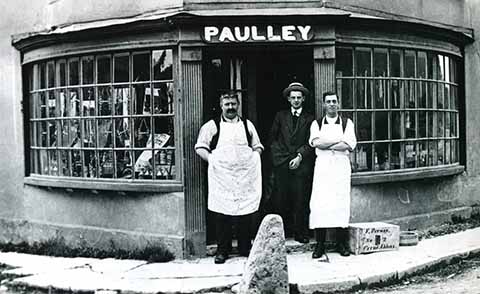
A second ‘Valuable Corner Block’ at the corner of Long Street and Duck Street included a saddlery and was bought by saddler and harness-maker Henry Paulley for £250. The grandson of one of Paulley’s tenants still lives there, making it the only property to remain in the same family for 100 years. The only shop that has not changed its usage in that time is today’s Cerne Abbas Stores in Long Street, which was on the market for £750,000 in 2015. It was also a general store in 1919, when it was sold as ‘the Double Shop’ for a mere £350 to tenant shopkeepers H Waygood and Co. Waygoods also paid £25 for their Long Street storeroom, called the ‘Salvation Army Barracks’ in the schedule, as it had previously been used by that organisation after serving as a Wesleyan chapel even earlier.
Pubs in the auction included the New Inn, which had been tenanted to Blandford brewers Hall & Woodhouse but in 1919 was snapped up by their Dorchester rivals, Eldridge Pope & Co, for £650. They also paid £21 for an adjoining ‘Building Site’, which is now the New Inn car park. Eldridge Pope also bought the Union Arms in Acreman Street for £360. At 2 Long Street, Lucy Earwaker’s Refreshment Rooms (£330) were among many premises bought by Arthur G Nobbs, who acted as agent for many tenants. It was re-sold three months later but not to Miss Earwaker, who later re-opened her refreshment business at 32 Long Street.
Dr Ernest Dalton, a Cerne Abbas GP for more than half a century, paid £1225 for his house, The Lodge in Long Street, complete with chauffeur’s cottage, garage and stabling. Miss Katherine Digby, of the Minterne Magna family, bought her home, Barton Lodge, for £1300. She also bought four cottages in Duck Street and Wills Lane to house her coachman/chauffeur, gardener and domestic servants. Builder Harry Tite paid £80 for his builder’s yard at what is now 18 Duck Street. Tite lived in one of the 520-year-old overhanging timber-framed cottages in Abbey Street, known as The Pitchmarket as the place where farmers displayed their corn on market days. Thomas Washington, reputed uncle of founding US president George, lived there 300 years ago. The terrace also included a motorcycle workshop and Tite bought that and all four surviving cottages for £350, later making handsome profits through sales to other purchasers.
Between them, the 77 lots raised over £67,000 – equivalent to £3.3 million today. But this was not quite the end of the story, as correspondence in the old Senior & Godwin files reveals details of several disputes. Three months before the auction, Mr Tite was accused of removing and selling a lead pump belonging to Mr Pitt-Rivers, while the man who bought it ‘in an open market at a fair’ said he resented Senior & Godwin’s ‘tone and remarks’. Nine months after the sale, Eliza Green – who lived in a cottage that formed part of the Abbey House lot – appears to have been holding out for compensation and was to be offered £400. Dubious shading in a map in the sale particulars led to a boundary dispute between the buyers of Abbey House and lot 40, cottages in Abbey Street.
H S Senior’s personal copy of the 64-page sale catalogue was among thousands of Senior & Godwin documents discovered last year in 200 hessian sacks in a former hayloft behind Symonds & Sampson’s offices at Sturminster Newton. Symonds & Sampson, who merged with Senior & Godwin in 1990, loaned the catalogue to Cerne Abbas Historical Society for their recent exhibition in the parish church marking the 100th anniversary of the sale. Events included an auction of fifteen lots by Duke’s auctioneer Garry Batt and an invitation to current owners, clothed in period attire, to ‘bid’ for their properties at 1919 values. Months of research by Historical Society members in the run-up to the eleven-day exhibition unearthed fascinating background stories that are retold in their 84-page full-colour Guide to the 1919 Auction Properties.
Copies of the Historical Society’s superbly designed Guide to the 1919 Auction Properties are still available from Cerne Abbas Stores (£5).